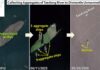

Five South Korean buses that appear to have operated in the Kaesong Industrial Complex were recently spotted in satellite photos, parked at the Wonsan-Kalma tourism zone in Wonsan, Kangwon province. Their length, color, and design match those produced by Hyundai Motor Company, confirming they are South Korean buses. Meanwhile, nighttime light intensity images captured on a late September evening revealed a five-kilometer stretch of the now off-season Myongsasipri Beach illuminated as brightly as daytime. This contrasts sharply with the darkness of residential areas where ordinary citizens endure chronic power shortages—a stark reminder that spectacular nighttime lighting displays continue daily at tourist facilities with no visitors.
South Korean buses in Wonsan-Kalma tourism zone parking lot

Five buses parked at the northern end of the Wonsan-Kalma tourism zone were captured in satellite photos taken in early September. The parking lot covers 1.8 hectares between the Risang Inn, Yolgwang Inn, mini-golf course, indoor water park, and Kalma Street. The site was originally a soccer field, but after Kim Jong Un visited in July last year and harshly criticized delays and design issues in the coastal tourist zone construction, the field was hastily demolished and converted into a parking lot.
Enlarged images show that the buses’ length, color, and design closely resemble South Korean buses that operated in the Kaesong Industrial Complex. They measure 10.3 meters long by 2.3 meters wide. Satellite photos reveal matching dimensions and color schemes among buses in the Wonsan-Kalma tourism zone parking lot, downtown Kaesong parking lots, and Kaesong Industrial Complex lots. The distinctive two-tone design—roughly half sky blue, half white—makes them easily recognizable.
The buses provided by South Korea during Kaesong Industrial Complex operations are believed to be Hyundai Motor’s “Aero City” model. Even after the complex closed in April 2013 and factory operations shut down completely in February 2016, these South Korean buses have continued serving as public transportation in downtown Kaesong. High-resolution Google Earth satellite photos clearly show Korean buses operating throughout Kaesong’s streets, with dozens parked in two large lots. When South Korean buses operating in Pyongyang appeared in North Korean state media, domestic South Korean news outlets reported on it, sparking criticism about their unauthorized use.
This appears to be the first sighting of Kaesong Industrial Complex buses at the Wonsan-Kalma tourism zone. Given that Hyundai-manufactured buses are superior to North Korean or Chinese models in design and performance, they’re likely prioritized for transporting tourists and VIPs at major events.
While the straight-line distance from Kaesong Industrial Complex to Wonsan-Kalma is about 150 kilometers, the road route via the Pyongyang-Kaesong and Pyongyang-Wonsan highways stretches to approximately 300 kilometers. Rather than transporting tourists directly from Kaesong to Wonsan, the five South Korean buses at Wonsan-Kalma appear to have been permanently assigned to the tourism zone for use exclusively within Wonsan.
Illuminated beaches in the dead of night, empty of people

The Wonsan-Kalma tourism zone continues displaying bright, vivid nighttime illumination even as autumn deepens. Nighttime light intensity imagery (VIIRS) from the U.S. weather observation satellite (JPSS), captured at 1:30 a.m. on Sept. 24, shows accommodation and entertainment facilities around Songdowon Resort and Wonsan-Kalma glowing brightly in the dead of night. By contrast, only scattered areas around downtown Wonsan and Wonsan Station show faint lights, while residential neighborhoods where ordinary citizens live remain cloaked in darkness.
On the East Coast, seawater typically becomes too cold for swimming after mid-August. The off-season Myongsasipri Beach is empty, with only an occasional vehicle or two passing along the deserted roads. North Korea is pursuing comprehensive tourism zone development aimed at attracting domestic and international visitors to Wonsan-Kalma during spring, summer, and autumn, while linking it with Masikryong Ski Resort for year-round, four-season use. Whether crowds of tourists will actually flock to Wonsan in Kangwon Province, bringing dollars and foreign currency, remains highly uncertain.