

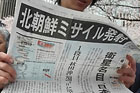
The United States government declared publicly for the first time on Monday their belief that North Korea probably really did conduct a nuclear test on May 25th. The possibility that the blast was created using conventional explosive, for example, had not previously been ruled out, with the relatively small size of the blast being partly responsible for the uncertainty.
The Office of the Director of National Intelligence (DNI) statement contained the following; “The U.S. Intelligence Community assesses that North Korea probably conducted an underground nuclear explosion in the vicinity of P’unggye on May 25, 2009. The explosion yield was approximately a few kilotons. Analysis of the event continues.”
However, the wording of the statement somewhat calls into question the certainty with which it was made, a topic that was raised with State Department Spokesman Ian Kelly at Tuesday’s press briefing. Asked, “But doesn’t the use of the word “probably” mean that there was no conclusive evidence there was a nuclear test?” Kelly responded, “I’ll just refer you back to the release of the DNI, that we assess that it was a nuclear test based on certain criteria, but that we continue to assess all the data.”
Meanwhile, Japan, by way of additional punishment for the nuclear and attendant missile tests, has cut off all remaining trade links with its belligerent neighbor. The ban covers all export trade and is slated to be in force until April 13th, 2010.
The majority of North Korea-Japan trade was already prohibited under an existing basket of sanctions that Japan imposed after the 2006 test, so the latest restrictions are seen by some as mostly symbolic. One AFP report quoted Korean affairs expert Lee Young Hwa of Kansai University, who agreed that “Japan’s additional sanctions won’t have a substantial impact on North Korea.” Japan exported goods worth just $8.2 million to North Korea in 2008.
The latest sanctions include some other provisions, notably that non-Japanese persons living in Japan who break any of Japan’s rules on interaction with North Korea will be denied re-entry to the country.
Other recent moves by Japan have included reducing by two thirds the amount of money that citizens can remit to North Korea without governmental approval. That limit now stands at approximately $100,000.







