

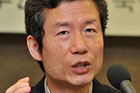
[imText1]Kim Young Hwan, a researcher for the Network for North Korean Democracy and Human Rights (NKnet) believes, “Since the North Korean system has already deteriorated a lot, if the North Korean people are given the opportunity then there is a high chance that the system will collapse at a swift pace.
Kim, who was speaking at an event hosted by the Human Rights Foundation this afternoon at the Press Center in Seoul, went on, “Though I am not saying that this collapse will definitely take place in the next two or three years, it is clear that the end is near.”
Explaining the impetus behind this proposed collapse, Kim added, “The distrust and dissatisfaction of the state and its leadership is gradually increasing” and pointed out, “the incompetence and corruption of the administration and oppression by the authorities etc are becoming more extreme, so the country cannot operate normally.”
Kim further noted , “Were Kim Jong Il to die or lose his faculties in the next few years, there is the possibility that the whole nation could fall into chaos as a result of influential military figures conflicting with Kim Jong Eun. The chances are that the people, who have become aware of foreign information and such like, may come to harbor a disestablishmentarian awareness.”
Kim predicted, then, that the chances of Kim Jong Eun succeeding are low.
“If the succession is not promptly sorted out, the system and higher ranks of North Korea’s upper echelons will begin to tremble, making it possible for officials to begin resisting,” he added, “you cannot expect the untrained Kim Jong Eun to have the capacity to deal with this sort of problem.”
“Since there is virtually no one to advise or help Kim Jong Eun with any sincerity, the chances of this problem becoming a major one are high,” he remarked. “Since he is destined to become an autocrat, it is highly probable that even if he makes a mistake, he will still be surrounded by those who have been consistent in fawning him.”
“Since he was raised abroad and was thoroughly isolated during his time in North Korea, he lived a completely different life than other ranking officials. As such, he has little awareness of customs. It is impossible to control officials only through a manipulated stature and fear,” Kim concluded.
Meanwhile, the President of North Korea Intellectuals Solidarity (NKIS), Kim Heung Gwang pushed for an emphasis not only on food aid, but on information aid as well, saying, “The desire and yearning of the North Korean people to experience the outside world is intensifying,” and “it is important that we expand our support of not only food aid, but showing and assuring them of the humanitarian aspect of international and South Korean society.”
He added, “Broadcast materials targeting North Korea are becoming an inseparable feature of their daily lives, to the point it is becoming difficult to completely block it, albeit by crackdown or by punishing those who have such materials.”
In order to improve the people’s right to know, he said that “from the outside, we have to make the conditions for the people to have the right to know,” and proposed, “The South Korean government needs to adopt a positive national policy of support.”







