

[imText1]On the Chinese site of the People’s Daily Online, the newsletter reported on the 9th that “Chinese merchants are waiting for North Korea to open.”
A Chinese businessman, Ho Hao (pseudonym) returned from Shinuiju in North Korea after losing US$20,000 from a bakery failure. Ho showed great zeal for investment as he said “If only I had another opportunity, I would conduct business again. North Korea is in dire shortage of goods, that if you invest, you can make alot of profits.”
The newspaper claimed that following the Feb 13 Agreement, businessmen have been furtively looking for investment opportunities in Dandong, an area known to be one of North Korea-China’s critical trade routes. The newspaper relayed, as North Korean leaders currently focus on economic reconstruction, “Some speculate that businessmen from Dandong will develop a new and exclusive economic province approx 24 km south of Dandong and Shinuiju.
North Korea analysts in China argue “There is no point in constructing an economic district in this area.” Yet, they agree that there are many aspects of North Korea investment that needs to be addressed. Nonetheless, “there is no guarantee that secondary victims such as Ho will not occur.” The newspaper assessed that the biggest issue was for North Korea to attract foreign capital through its shady system.
The newspaper criticized that the economic province constructed at the farthest Northeast region of North Korea, Najin and Sunbong but ultimately failed, as it was unable to maintain foreign capital due to geographical reasons. On the other spectrum, they praised Kaesung Industrial Complex, just 60km from Seoul for its great success.
With the construction of various processing plants, North Korean authorities proclaimed Shinuiju as an economic province in 2002. However, a variety of issues led to the failure of the economic province followed by instability to North Korea’s economic reform and the mood of peace on the Korean Peninsula.
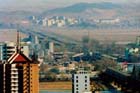
“As Sun, a merchant in Dandong sits in his office gazing across to the North, he sees trucks lining up to enter Shinuiju, waiting to be inspected by Chinese customs. These trucks enter North Korea full of goods in the morning and by evening they either return empty or full of minerals, silk cocoons or seafood. Vehicles which depart for North Korea 4 times a week basically contain goods such as daily necessities made in China, electrical products for the home and fertilizer,” the newspaper described to illustrate the active trade occurring between the two countries.
Sun said “Though trade is comparatively active, one must still be discrete as danger lurks at every corner… Transactions are made with Chinese Yuan, the dollar or euro. North Korea won is not used,” informed the newspaper.









