

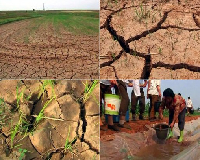
As a severe drought takes hold of North
Korea, it has been reported that serious damage to farms resulting from a huge
influx of seawater into the rivers of the western plains is expected. Sources
have reported that the damage to farms is increasing as seawater flows into the
rivers, whose water levels are low due to the drought.
“Recently, the huge drought that has swept
across the entire region has been severely damaging rice, corn, potato, and
other crops. In particular, the water levels in the rivers that flow through
the ‘rice bowl’ regions of South Hwanghae Province and South Pyongan Province
(including the western plains region) have been so low that a large amount of
seawater has flowed in, rendering the water completely unusable for agricultural
purposes,” a source in South Pyongan Province told Daily NK via telephone on
June 17th.
The river water, which should flow to the
sea, is 3~4m below its previous levels, leaving the entire riverbed exposed and
the ground completely dried out, she said, explaining, “Because of this, at high
tide the seawater flows back up the river several kilometers and the river has
become salinated.”
“When saline water enters
farmland, the roots of the rice plants lose their vitality and have an enormous
effect on the branches of the rice plants; as a result, the rice crops are
going bad,” she asserted, lamenting that farmers and workers have little
choice but to stand around waiting for rain.
Floodgates on rivers cutting through
Hwanghae Province and the provinces of North and South Pyongan would suffice to
effectively block the influx of saltwater, the source pointed out, but a dearth of such mechanisms has the authorities scrambling
to mobilize everyone from farmers to soldiers to mitigate damage wrought by the
drought.
This source has dealt with the deleterious
effects of the drought firsthand, and as such contended that the only viable
solution going forward is for the state to invest in floodgate infrastructure.
Temperatures in the western plains region,
which includes Pyongyang, have been rising sharply since the beginning of
spring, recently soaring above 30 degrees Celsius. Due to the heat, the rural community
support projects for rice planting have been delayed, with citizens mobilized
for the cause having a difficult time working outdoors.
“Plowing rice paddies that have already
been planted is impossible and they have already started to cut paddies that
haven’t been irrigated. Corn, potatoes, vegetables, and other crops have been
withering for a long time,” she said.
“When our country was affected by a
serious drought last year, we prepared water jugs and used those, but this year
it is more than twice as severe.”
A source in North Pyongan Province also
weighed in on the situation, noting, “Although current newspapers and
broadcasting stations are reporting that 80% of the rice planting is already
finished, our province hasn’t even completed half of the rice planting yet.
With the exception of the major producers, all of the regular farmers, lacking
water, have to use a dry planting technique where we plant rice seedlings by
digging holes in the ground with wood.”
North Korea has routinely implemented this same practice in the past during its most severe droughts.
Residents have wasted no time pointing out
the innumerable flaws of forced farming policies pushed on an innocent
population under a state consistently failing to make the necessary national
investments in agriculture, he asserted.
“The bellies of the executives are full, so
they don’t care about (farmers),” he concluded, citing one of many grievances expressed
by those toiling on the farms.









