

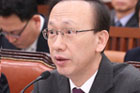
“A situation of rapid democratization will not break out in North Korea like that in the Middle East and North Africa,” Hyun In Taek, the South Korean Minister of Unification told a morning forum on North Korea policy today, but “at least we are sensing changes.”
Minister Hyun explained to the forum, “Latest Inter-Korean Relations and Policy on North Korea,” held by the Korea Institute for Defense Analyses (KIDA), “Residents in the border regions are communicating with outside society and watching Chinese and South Korean videos.”
However, he added, “Even though facts are circulating by word-of-mouth across the country, it is still uncertain whether this change can have an impact on North Korean freedom and human rights or not.”
Minister Hyun also reiterated once again that North Korea needs to act with sincerity and move towards denuclearization if it wants to realize an improved relationship with South Korea.
He went on, “The President has also said that we have left the door to dialogue open and that the basis of policy on North Korea is still to solve things through dialogue.” However, he pointed out, “If inter-Korean relations are to become future-oriented, we do have to address the Cheonan and Yeonpyeong Island problems.”
He continued, “If we cannot accomplish North Korean denuclearization, we cannot guarantee the future of East Asia and the Korean Peninsula,” and added, “North Korea will not be able to survive in closure and isolation. Therefore, it must come out down the path of reform and opening.”
However, he went on, “An inter-Korean Summit is under review, but there is no process,” and pointed out, “The Summit is necessary in principle, but what is the ultimate purpose of the dialogue? This is the point.”







