

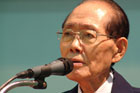
Hwang Jang Yop, the President of the Committee for the Democratization of North Korea, is of the opinion that the North Korean military will never take power after Kim Jong Il’s incapacitation because the political foundation does not exist in North Korea’s military circles.
Hwang said at an informal gathering with university students in Seoul on the 16th, “Whether the military or the Party will seize power [after Kim Jong Il’s death] remains to be seen, but the North Korean military only knows strategies for battle and does not know politics. The reason for North Korea to continuously emphasize the military is to threaten South Korea and the North Korean people, not to strengthen the military’s political role.”
He added, “When Kim Jong Il goes to onsite inspections, he is not accompanied by members of the political elite with actual influence. He is only choosing the retinue for the inspection according to how deeply loyal they are to himself. It bears no relations to how many stars (badge of rank) they are wearing.”
He said regarding the possibility of a military coup if something were to happen to Kim Jong Il, “In order to carry out a coup, significant political foundations are required and as long as organizations of the Party are parts of the military structure, a revolt will be difficult. In some countries where politics are not developed and not well-systematized, the military can seize power, but currently in North Korea, it is difficult to find military figures with much power.”
Hwang cited the example of the “Sixth Army Corps coup d’etat” which occurred in 1995, explaining, “The masterminds of the coup were gathered in an auditorium and all executed. The person who executed this was Kim Young Choon, the Vice-Chairman of the National Defense Commission, but the political manager behind Kim Young Choon was Jang Sung Taek, Kim Jong Il’s brother-in-law. This is a clear instance demonstrating that the executive operator and the political manager with true responsibility for given actions are different individuals.”
Further, he pointed out, “The military also previously operated the system by which the Army Chief of Staff and the Director of General Political Department of the Army reported to the Defense Security Command of the Army. But it is now difficult for these three figures to gather their strength for a military coup, because Kim Jong Il reorganized the reporting system for these three military officials so as to report every issue directly to Kim Jong Il.”
Hwang emphasized in particular, “One must have political influence to seize power in an environment such as North Korea’s. Even in the Guidance Department of the Central Committee of the Party, whoever has the greater political backing and power among the First-Vice Directors will be selected as the power holder.”
Regarding the succession in the North, Hwang noted, “If Kim Jong Nam, who has support from China, seizes power, opening and reform will be more feasible, but the Supreme Leadership System will be left as it is. This is unlikely to be opening and reform in the Chinese way. However, South Korea must observe the situation and establish a responsive strategy.”
On China’s role in the case of an emergency situation in North Korea, he explained, “If chaos results in North Korea and the U.S.-ROK joint forces enter the country, China will not keep silent. If confusion results in the North due to the succession, China will not be able to officially intervene, but will still have strength to control Pyongyang beyond watching eyes.”
Hwang expressed, “However, getting worked up about an emergency state of affairs in the North is unnecessary. As long as China, who has a degree of understanding with North Korea, supports the country, the likelihood of significant confusion is small.”
Moreover, he said, “Kim Jong Il naturally passing away is an inevitable event and North Korea has been preparing for this for a long time. From this perspective, Kim Jong Il’s death is a normal event and cannot be viewed as an ’emergency.'”







