

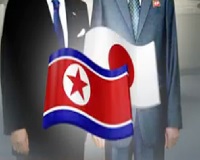
North Korea’s community of Korean-Japanese is
coming back into vogue now that relations between Pyongyang and Tokyo are showing signs of improvement, Daily NK has learned. The recent bilateral agreement between the
two countries incorporates the removal of some of Japan’s unilaterally imposed
sanctions on North Korea, and this has plenty of people licking their lips for the future.
“We’re hoping that if relations between us
and Japan do get better then [Japanese] sanctions will go and trade can
restart,” a source from North Pyongan Province told Daily NK on the 7th.
If Japanese products began
to circulate widely in the North Korean economy once more, the source went on, then the
Korean-Japanese community could again be a viable economic competitor
for the “hwagyo,” the community of overseas Chinese living in Korea.
Korean-Japanese first began to return to North
Korea in 1959 under the rubric of the highly controversial “Homecoming Project”, which was run by Chongryon, North Korea’s de facto consular representation in Japan. By the end of the project in 1984, the community had grown to number more than 100,000.
In the outside world, the best known of
this first generation of Korean-Japanese returnees is Kim Jong Eun’s mother Ko
Young Hee. Ko, the so-called “Mother of Military-first Chosun,” was born in
Osaka to parents of Korean descent (from Jeju Island), then travelled to North
Korea with her parents in the early 1960s.
Many of the early arrivals lived well thanks to their access to remittances and goods coming across the East
Sea from Japan. One result of this trend was that by the 1980s, Korean-Japanese
occupied many of the senior management positions in North Korean
foreign-currency earning firms (with native North Koreans from the Chosun Workers’
Party providing ideological and political oversight).
In the 1970s and 80s, Chinese demand for
second-hand televisions made by Japanese brands Toshiba, Sony, Sanyo and
Hitachi was high, providing an opportunity for the Mankyungbong-92, the ferry that plied the route from Niigata in
Japan to Wonsan in North Korean Gangwon Province, to act as a node bringing the desirable Japanese electronics to Chinese traders via North Korea.
At the time, a reconditioned
television sold to Chinese traders could fetch 35,000-40,000 North Korean won,
enough to cover the monthly salaries of 500 North Korean workers. Watches made by the
Japanese brand Seiko were also popular with North Korean elites of the day,
selling for up to 10,000 won.
However, by the 1990s the Chinese economy had begun to gain momentum, and nowhere was this felt more keenly than in
North Korea, where trading rights began to pass into the hands of ethnic
Chinese or others with Chinese relatives. This situation persists into the
present day; indeed, with Japan’s outright ban on port access bringing the curtain
down on the regular ferry link with Wonsan in 2006, conditions got worse.
“In the event that trade with Japan
restarts and Japanese goods do begin to enter North Korea, this will inevitably
limit the market for Chinese products,” the source declared. “After all, North
Korean people would far rather have a second-hand Japanese item than a brand
new Chinese one […] That’s why the hwagyo
don’t want North Korea-China relations to improve.”
“People with power and the foreign-currency
earning firms look like coping with the changing circumstances by co-opting Korean-Japanese into the fold,” he went on. “Thus, if North Korea-Japan trade
happens, the hwagyo expect the value of their trade through China to markedly decline. Both they and their Chinese trading partners do
not feel comfortable about this.”









