

[imText1]
The North Korean Human Rights Law, put forward by the ruling Grand National Party, and the North Korean Livelihoods and Human Rights Law, put forward by the opposition Democratic Party, are expected to clash in June’s extra session of the National Assembly. Amidst this contest lies a key question: the effectiveness of the two laws.
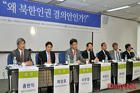
Experts from both parties met to discuss this during a panel discussion co-hosted by the Korea Diplomatic and East Asian Peace Research Society and the National Assembly Research Service (NARS) on the morning of June 9th at the National Assembly Library, sparking a heated debate.
Opening with comments on why he supports the NKHRL, Yoon Yeo Sang of the North Korean Human Rights Record Depository explained, “The North Korean Human Rights Act provides for both protection of the right to life and humanitarian assistance. There is absolutely nothing lacking about the law, it would be difficult to find fault with it,” and added, “It is very hard to justify opposition to the law from the viewpoint of humanitarian assistance.”
Nevertheless, taking a conciliatory position, he also noted, “Just the fact that the Democratic Party is participating in this discussion itself is welcome. Though I do not know what the substance to the North Korean Livelihoods and Human Rights Law is, in the end it will also provide for humanitarian assistance.”
However, others were less accommodating. Jae Sang Ho, a professor with Joongang University, offered stark criticism of the Democratic Party, asserting, “This is a law that went 16 months without any alternatives being offered, so to call for discussion having come this far seems like delaying tactics. The Democratic Party seems to be trying to earn more time in which to block the passage of the NKHRL.”
Across the table, however, supporters of the competing legislation offered their criticisms of the NKHRL.
Lee Woo Young, a professor from the University of North Korean Studies insisted, “The enactment of the North Korean Human Rights Law is likely to raise tensions between the two Koreas,” adding, “The basis for claiming that enacting the North Korean Human Rights Law will improve North Korean human rights is weak.”
Hong Hyun Ik, a Sejong Institute national security strategy researcher, agreed, pointing out, “We not only do not provide aid to North Korea, we don’t even listen to China’s suggestions. In this situation, even if we enact the NKHRL, will it have any effect?”
“The current government and the conservative camp, which use extra grain as animal feed but does not offer any rice to North Korea, is just launching empty political attacks against the progressive camp by saying that they have no sincerity in terms of North Korean human rights.” Kim Geun Sik, a professor at Kyungnam University, complained.
Concluding events, Yoon finally noted sadly, “The North Korean human rights problem has not been at the core of inter-Korean relations to date, and it is hard to see any groundbreaking developments hereafter. Since North Korean officials are the perpetrators of this and their only solution is ‘Juche,’ they need to make an effort to solve it themselves, together with the outside world.”







