

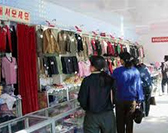
The popularity of South Korean goods in Pyongyang shows no sign of abating, Daily NK has learned. Indeed, thanks to the prevailing mood, sources claim that the number of people seeking out expensive but high quality goods from “the neighborhood down below” continues to rise.
A source from the North Korean capital reported to Daily NK today, “Most of the grasshoppers [illegal traders] in the alleys around Tongil Market here in Pyongyang are selling South Korean goods. Nice South Korean women’s jackets now go for about 300,000 won; although that’s around twice the price of last year, they still sell. That’s to say nothing of the used clothes.”
According to the source, a significant proportion of Party cadres, moneymen and even popular entertainers and artists have connections with Chinese-Koreans based in (or linked to) South Korea, and it is through these chains that many of the South Korean clothes enter North Korean markets.
Sharp-witted traders have long used residences in the vicinity of markets as de facto stores for the sale of illicit products. Those security agents who would otherwise be obliged to stop the practice can be bought off with some of the goods, sources report.
South Korean clothing is popular in North Korea because the manufacturing quality is generally high, and they feel superior to both North Korean and Chinese alternatives, North Koreans admit. “You only have to wear something made here once and it starts to look fairly sad,” the source acknowledged. “Conversely, South Korean goods are more resilient and can be worn for years. Once you’ve worn South Korean products often enough, you’ll know them just from the feel.”
But above all, South Korean designs are generally more interesting and fashionable than their domestic or even Chinese alternatives. Many North Koreans, in particular those with political and economic power, have had access to South Korean broadcast media for a number of years, and this has tended to reinforce popular interest in South Korean trends.
The source said that until the closure of the Kaesong Industrial Complex earlier this year, even products from the inter-Korean manufacturing zone could sometimes be found on sale in officially sanctioned markets. However, she went on, “After that [the closure] the authorities started clamping down, so you won’t find such products on sale in official markets now; seemingly they are only in the alleys around markets.”
“300,000 is quite a lot of money,” she noted. “Given that rice is about 5000 won per kilo at the moment, it’s enough to buy 60kg. But then, although that is a lot of money to a lot of ordinary people, there are plenty of Party cadres and big traders who can spend that kind of money.”
Tongil Market now sees a daily total of approximately 3000 “grasshopper traders”, according to the source. “Grasshopper traders” are so-named for the practice of leaping up and moving on when ordered to cease trading by members of the security forces.








