
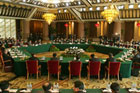
As chairman of the six party talks, China proposed on the 10th to resume the next round of negotiations in Beijing on July 18th. It seems that the upcoming talks will focus on discussions related to specific measures in disabling North Korea’s nuclear armaments.
Once the remainder six party member states agree to the date set by China, the negotiations will be fixed to start on the designated date. The talks resume 4 months after the first round of the 6th six party talks which recessed on March 22nd without much conclusion.
Many agree that the first priority of the upcoming talks will be to evaluate implementation of the initial actions of the February 13 Agreement. Further, the first allotment (6,200tons) of 50,000tons of fuel which the South Korea will send on the 12th is scheduled to arrive at North Korea on the 14th. On the other hand, North Korea has revealed that it would cease operations at Yongbyun nuclear reactor in accordance to this date.
In addition to this, on the 9th, North Korea consented to future visits by the International Atomic Energy Agency (IAEA) in order to conduct inspections and regulations on the disablement of Yongbyun nuclear reactor in North Korea. Following, an inspection team will visit North Korea around the 14th~17th to install video cameras and directly confirm the abolishment and disablement of Yongbyun nuclear reactor.
Subject to disablement are items on the `94 Geneva Agreement including the 5MW Graphite-Moderated Reactor, radioactive chemical laboratory, nuclear fuel rods manufacturing factory, 50MW nuclear reactor at Yongbyun and 200MW nuclear reactor at Taechun. However, the disablement of the 50MW nuclear reactor and 200MW nuclear reactor are low as operations were suspended during time of construction.
In order to begin the disablement, the IAEA plans to disable the 8,000 nuclear fuel rods in the reactor as they stand, though this conflict with the `94 Geneva Agreement. If regulations and an inspection team visits North Korea on the 14th, the disablement of the nuclear facilities should be made complete by the 28th.
Though a greater number of experts are optimistic towards North Korea implementing the February 13 Agreement, denuclearization is a completely different agenda. The upcoming six party talks plan to evaluate North Korea’s disablement of nuclear facilities and then further discuss the next stage of denuclearization and a list of all its nuclear programs.
The February 13 Agreement states that “The DPRK will discuss with other parties a list of all its nuclear programs as described in the joint statement, including plutonium extracted from used fuel rods, that would be abandoned pursuant to the Joint Statement.”
It seems that the U.S. plans to proactively intervene in the negotiations regarding the complex HEU program according to the February 13 Agreement. It is possible that the U.S. will even engage in bilateral talks with North Korea in order to closely examine suspicions of North Korea possessing HEU programs.
Meanwhile, U.S. Assistant Secretary and head delegate of the six party talks Christopher Hill will be making visits to Japan and Korea as of this weekend in order to suggest proposals of cooperation to implement the February 13 Agreement.