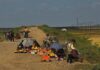

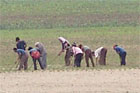
Changchun, China — Reports from inside sources in North Korea state that the volume of North Korea’s food production this year is at a critically low level. Concerns among local citizens have also been rising regarding the emergence of a new food shortage in the upcoming winter season.
A source from Yangkang Province relayed in a phone conversation with the Daily NK on the 31st, “With rumors that this year’s farming was ruined increasing, the prices of rice and corn have risen over 200 won each. In the market, not only the market managers but also officials of the People’s Safety Agency have been mobilized to regulate price levels.”
Based on price levels in the Hyesan Market as of August 30, Chinese rice was sold at 2,400 won per kilogram and corn at 1,000 won per kilogram. Until July of this year, the cost of rice and corn were 2,000 won and 800 won, respectively. Such a price increase has also been confirmed in major North Korean cities, including Pyongyang, Hamheung, Chongjin, Sariwon, and Shinuiju.
According to sources, North Korea’s agricultural sector suffered considerable damages this year from torrential downpours throughout the nation, cold-weather damage and damage from blight and harmful insects.
Due to low temperatures, which continued into July, the primary farming season, wheat and corn crops experienced stunted growth. Even bean farming which the North Korean authorities stressed as a matter of priority this year saw disappointing results.
The Yangkang Province source said, “According to the cadres of the Yangkang Province Agricultural Accounting Committee, this year’s farming only amounted to 65 percent of last year’s production. By and large, the yield from farming was insufficient this year.”
He explained, “In Yangkang Province, the yield from potato farming was similar to last year’s in Daehongdan, but other counties, including Baekam, experienced huge losses compared to last year. In the case of Daehongdan, the ground itself is half volcanic and half humus soil, so even with heavy rainfall, the water tends to dissipate rather quickly, not affecting the harvest too significantly.”
A source from North Hamkyung Province also said, “Each collective farm has started to evaluate its estimated crop yield. This year’s agricultural yield is estimated to be around 60 percent of last year’s.”
Then, he emphasized, “This year, there was heavy rainfall and the climate was cold, contributing to a failure in farming in the regions in the vicinity of the sea. In particular, the pine mushroom harvest was disappointing this year.”
Further, marine industries in the North Hamkyung Province region suffered a major blow when cold water from Russia lowered the water temperature off of North Hamkyung’s coast, adversely affecting herring and sand eel harvests in the East Sea. The source commented, “This year’s climate not only impacted farming but also foreign-currency earning. Foreign currency earning organizations in the region have been in a state of panic because they have been unable to secure marine products including clam, anchovy and echinoid eggs nor wild greens such as pine mushrooms, ferns and others.”
Agricultural experts who recently visited North Korea have also observed the deterioration of North Korea’s agricultural production. Dr. Han Myung Il, a World Vision agricultural expert who visited North Korea from the 1st to the 8th this month, commented in an interview with Yonhap News on the 31st, “Perhaps due to a lack of fertilizer, rice plants did not attain the ideal height and even appeared yellowish in color.”
He expressed worriedly, “In the situation where fertilizer aid from South Korea has been at a standstill for two years, despite the fact that the North produces manure itself and uses compost if needed, fall harvest will no doubt be affected due to the insufficient volume and the inferior quality of the fertilizer produced in North Korea.”
Meanwhile, a potential correlation between North Korea’s recent appeasement policy towards South Korea and the emerging agricultural crisis can be observed. According to government officials, the North Korean delegation, which participated in the inter-Korean Red Cross talks at Mt. Geumgang from the 26th to the 28th, noted the surplus of rice in South Korea and circuitously expressed its hopes of receiving humanitarian food aid again.
Although North Korean officials proposed the issue in a roundabout manner, this discussion of food aid, in the form of rice deliveries, from South Korea is the first since the Lee administration has come into office.