

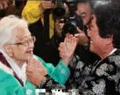
There has still been no clear response from North Korea to the idea of working-level Red Cross talks aimed at organizing a future round of separated family reunions, as suggested by South Korea on the 14th.
However, the government is cautiously optimistic that North Korea will agree to the South Korean government’s proposal. Park Sujin, a vice-spokeswoman for the Ministry of Unification said of the issue yesterday, “North Korea had not received the notice as of this morning”, but added, “We will wait until North Korea responds.”
There is some speculation that North and South Korea agreed on the issue beforehand, with South Korea sounding out the North to see how it would be likely to respond.
Overall, a government official noted yesterday, “The government’s stance is that North Korea has to join such working-level contacts. Given the nature of family reunions, it looks as if North Korea will agree.”
“Recently North Korea promised to take part in North Korea-U.S. dialogue, and if North Korea can be said to have focused on internal problems until now, there is the possibility that they will take active part in external relations going forward, and therefore there is more chance of their being a part of inter-Korea dialogue.”
Prof. Yoo Ho Yeol commented to the Daily NK, “North Korea’s condemnation of South Korea’s government implies that they will not continue any kind of dialogue; but, since this is a humanitarian issue and there is a U.S.-North Korea dialogue, it looks like they might well appear”
However, experts predict that even if North Korea agrees to the working-level talks, actually realizing a round of reunions will be hard. In the past, North Korea has routinely demanded rice aid in exchange for reunions of separated families, and this is liable to happen again. Yet it would be hard for South Korea to agree to, given the overall political landscape as the 2nd anniversary of the Cheonan sinking approaches.
Professor Yoo commented, “If North Korea were to join working-level talks then they will be able to judge whether the government has the intention to give food aid or not. Moreover, although they will not ask for the total disbandment of the May 24th measures, they will expect substantial changes”.
Additionally, some strategic analysts point out that North Korea will not want to get involved in talks because Kim Jong Eun is currently employing strained inter-Korean relations to stabilize his system.
Oh Kyung Seob, one such researcher at the Sejong Institute said, “It is unlikely that North Korea will respond because Kim Jong Eun and his new system have no control over the state of inter-Korea relations. They have declared that they will never deal with the Lee administration and the National Defense Commission demanded nine things following the Kim Jong Il condolence issue, so it is unlikely that they will enter a dialogue.”







