

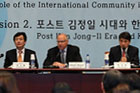
[imText1]“Human rights are the moral voice of our times,” says Japanese journalist Jiro Ishimaru.
In the words of Lousia Greve of the National Endowment for Democracy, “being silent serves no purpose.”
To British Embassy staff member Richard Cowin, “Anything is better than the status quo.”
The precise ways and means may be open to debate, but there is no question that the panelists in experts’ workshops during the 2009 International Conference on North Korean Human Rights agree; there is no other choice but to deal with North Korean human rights immediately, consistently, and in practical ways.
One panel member from the Grand National Party spoke about his view of South Korea’s own North Korea Human Rights Law, saying, “The human rights situation of North Korean citizens as well as that of refugees in third-party countries is really serious.”
Gu Sang Chan went on, “But according to the Human Rights Law, which is still pending, a North Korean citizen is described as those whose address, family, spouse, and workplace is north of the MDL. Then, the target of the law is just North Korean people residing within North Korea, excluding refugees in foreign countries. However, these two groups are very closely related.”
“Human trafficking targeting female defectors, forced repatriations and punishments, as well as refugee childrens’ statelessness, are all serious and urgent.”
His view was just one that could be heard during the session, for regardless of who or what exactly each wishes to target, the panelists all agreed with Lousia Greve’s simple proclamation; we must research North Korean human rights issues no matter how hard it is to get information, and then relentlessly document human rights abuses by the North Korean regime. We must assist defectors to found organisations, create projects, and learn to speak for themselves. We must help the North Korean people to stand on their own two feet, through scholarships for defector students in all spheres of study, so as to provide experts who can govern North Korea in the post-dictatorship future.
Nations must cooperate, agreed Cowin, in addressing all of these issues, not leaving it to one or the other to shoulder the burden. NGOs must cooperate, wherever they are from, whatever their unique position, added Ishimaru.
For it is true that, as Chuck Downs of the US Committee for NK Human Rights said, “Those who have the freedom to speak must speak,” for “we represent the people who are free.”







