

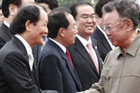
[imText1]I telephoned a reporter who visited Pyongyang for the inter-Korean Summit to confirm the words spoken by novelist Cho Jung Rae. Mr. Cho is most well known for his novels on the tragic modern history of Korea and the struggle between Koreans over ideology.
Cho, who went to Pyongyang as part of the South Korean entourage, described in a radio talk show a dinner party hosted by Kim Jong Il himself. “(Kim’s) voice was so loud that it reverberated in the huge hall, and he drank wine almost endlessly. We can’t say his health has deteriorated at all,” Cho said.
Since Kim’s health has been attracting everyone’s attention, I was curious to find out how many glasses Kim actually drank. Reporters, however, were out of the dinning room at that time.
According to Unification Minister Lee Jae Jung, the novelist’s description was quite exaggerated. Last Wednesday, Lee told S. Korean political newspaper editors that Kim actually drank only a small amount of wine.
According to South Korean philosopher, Kim Yong Ok, Cho allegedly wept with pride while watching a video tape of the West Sea (Yellow Sea) Floodgate construction. The West Sea Floodgate was North Korea’s most proudest construction project in the `80s that cost billions of dollars. The floodgate, however, did not turn out to be that effective, given Pyongyang was again hit by huge floods this summer. Rather, many defectors testify that the project hurt North Korea’s already weakened economy.
From Kim Yong Ok’s personal account, when he went to take a picture of the gigantic Kim Il Sung statute in Pyongyang, he was stopped by Cho who said “Don’t take picture of the top, but take the bottom (where N. Koreans left their flowers).” Cho added, “We can criticize the regime, but the flowers represent people’s sincere devotion.”
One of Cho’s novels features Korean people’s hardship during the Japanese invasion. The Korean men and women’s plight under Japanese colonial rule was vividly depicted.
However, under the Kim Jong Il regime, millions of North Koreans have died of starvation. And hundreds of thousands have left their homeland and are meandering overseas. Another hundreds of thousands are imprisoned in concentration camps. The Korean people were not only repressed by Japanese imperialism.
If flowers dedicated for Kim Il Sung are sincere devotion, what about Korean conscripts’ forced pledge of loyalty to the Japanese Emperor?
Flowers dedicated for Kim’s statute must be live ones. Thus, local residents have to go to mountains to seek flowers before April 15 and July 8. If live flowers cannot be found, then he or she should buy them. There is no excuse and no exceptions.
Cho also commented on the Arirang mass gymnastics performance. In his own words: “The performance is listed in Guinness Book of World Records. It is so active and artistic. I regret that it includes regime propaganda, but still the Arirang is a must-see spectacle. If North Korea opens its society like China or Vietnam, it will make for a good tourist attraction.”
I wondered if Cho had misunderstood the meaning of “open society.” In an open society, parents would never have their kids undergo such hard training, even if paid, for state propaganda.
It cannot be a minuscule complaint to criticize Cho’s remarks. Cho is one of the most influential writers of our time. He cannot just be mesmerized by Pyongyang’s propaganda and distort the facts.
Sometimes ignorance is a sin. If committed by a person who has influence over many people, it is an even greater sin.







