

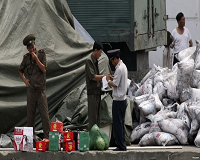
With springtime farming preparations well
underway, the North Korean authorities are said to be forcing traders to do business in fertilizers
only, even going as far as ordering trading companies around the country to import
fertilizers over all other goods, Daily NK has learned.
“A
few days ago, state branches affiliated with the Cabinet and trading companies
of various tiers [categorized by the number of workers] were ordered to prioritize
fertilizer imports over all other tasks,” a source from North Pyongan Province
told Daily NK on Monday. “The Cabinet ordered the State Planning Commission to stop
issuing licenses that don’t involve the import of fertilizers.”
She added, “Customs
offices along the borders have also received orders to regulate the inflow of
all items other than those of national importance.” The firms have not been allotted specific quotas, but instead were told their loyalty will
be evaluated based on the final imports and thus upping the competition between them.
Because
of this, trading companies and foreign-currency earning enterprises placed importing fertilizers as the primary goal for the first quarter. This, of course, stems from the fact that failure to meet the quotas during this period would exclude them from receiving trade
licenses until the end of this year, according to the source.
Trading companies of all tiers are required to submit every February a report on
quarterly export and import plans. Based on this, they receive trade licenses–without them they are unable to conduct normal trade with firms in China. Officials are able to force traders into
importing fertilizers using the issuance of trade licenses as leverage.
“The
heads of these state-run firms have no choice but to move quickly to secure
fertilizers in their effort to avert any disadvantages, but they are requesting
cheap fertilizers from Chinese traders in order to cut down on costs,” she said. “The result is an influx of cheap fertilizer of bad quality
since all traders care about is lower costs.”
The directive echoes a similar one dating back a few years, wherein the
state ordered trading companies to import chemical fertilizers. Naturally, organizations procured the cheapest–and in this case poorest quality– option available.
“Farmers, who complain about the inefficacy
of these Chinese fertilizers and the amount wasted, point out how these
directives do little–if anything– to help secure a bountiful harvest,”
the source explained. Joining in on the criticism are trade officials, who scoff at state propaganda touting the domestic “day and night
production” of fertilizer when they know, as is generally the case with state media, how far it strays from reality.









