

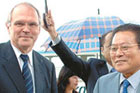
Following U.S. Assistant Secretary Christopher Hill’s visit to North Korea, the obstacles which blocked North Korea’s disablement of nukes seems to be unraveling at a rapid pace.
On discussing the progressions of the recent visit to North Korea, Assistant Secretary Hill said on the 23rd, “The talks were very detailed, very substantive… also very useful and positive.” Furthermore, he seemed rather optimistic that the North would now be ready to abide by the Feb 13 Agreement.
On the same day, a North Korean spokesperson for foreign affairs said in response to the Chosun Central Broadcasting that both parties had agreed to outline proposals and begin negotiations at the six party talks in early July, as well as ASEAN Regional Forum to be held in the Philippines in early August.
Prior, a press conference was held in Seoul following Assistant Secretary Hill’s visit to North Korea where it was openly revealed that North Korea was positive about discussing negotiations for the six party talks in early July and the next ASEAN Forum.
However, while departing from Seoul on the 23rd, Secretary Hill said regarding the upcoming 6th meeting that the U.S. really desired the meeting to take place in late July to swiftly make up for the “lost time.”
◆ Normalization of U.S.-North Korea relations – What’s first priority, denuclearization? = As Secretary Hill was leaving Pyongyang, a Chosun Shinbo Chongyon (General Association of North Korean Residents in Japan)-based newspaper) reporter questioned, “Is the U.S. priority to normalize relations with Chosun (North Korea) or denuclearization?” in which Hill replied that a positive resolution was desired of which the denuclearization of the Korean Peninsula was an important element.
Regarding this, the Chosun Shinbo reported, “Chosun will promptly make adjustments if similar to the past, the Bush government does not prioritize its goals to ‘remove nuclear armaments’ but aims to develop the relations of the two countries with comprehensive resolutions.”
From North Korea’s perspective, normalization of U.S.-North Korea relations means upholding the Kim Jong Il system while removing the threat of the U.S. Army such as removing U.S. troops in South Korea and conspiring against the militaristic alliance between South Korea and the U.S. On top of this, North Korea has wanted for a long time, to break free from the U.S. economic sanctions.
In the end, rather than scrutinizing over the issues of what each party considers to be a “comprehensive resolution,” it seems that the two parties have simply agreed with the mutual goal of finding a resolution.
However, the issue arises over the extent in which the U.S. places weight on the “denuclearization of the Korean Peninsula” and how long it intends to prolong the normalization of relations, whereas in comparison, it is an undeniable fact that North Korea places interest in developing relations with the U.S. over disabling its nukes.
If as North Korea requests, the U.S. prioritizes normalizing relations over the disablement of nukes, there are concerns that the aim of the six party talks may be shaken. Then the notion of Secretary Hill’s “comprehensive resolution” from the recent visit to North Korea will be open to debate.
◆ Extent of implementing February 13 Agreement post-BDA? = The initial actions of February 13 seem to be casting light with the resolution of the BDA and Secretary Hill’s visit to North Korea. However, a great number of North Korea analysts are not very optimistic about North Korea’s willingness to disables its nukes.
First, many analysts argue that there will be imbalances to the reports even if North Korea does disables its nuclear facilities at Yongbyun and reports all its nuclear programs surrounding its highly enriched uranium (HEU).
In an interview with Radio Free Asia on the 23rd, James Kelly, former U.S. Assistant of State for East Asian and Pacific Affairs mentioned that it was critical that all the HEU programs were reported even if North Korea agreed to dismantle the Yongbyun facility and said that this process would be extremely difficult.
Furthermore, it is possible that North Korea will draw the issue of normalizing itself on the international financial market even though the BDA issue has now been resolved.
A North Korean foreign affairs spokesperson said on the 22nd, “Both Chosun and the U.S. will create proposals and discuss ways to strengthen and cooperate in international financial transactions once the BDA issue is complete.”
On the 13th, the Chosun Shinbo stated, “Chosun does not limit the restoration of the $25mn as an end to the financial sanctions” and reported, North Korea’s requests as “the ability to freely transact as if it was before the BDA issue,” suggesting yet another possible obstacle to the Feb 13 Agreement.