

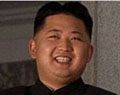
[imText1]It has now been a little over a year since Kim Jong Eun was formally revealed as successor to his father, since when there has been no shortage of opinion about the likely success, or otherwise, of this particular quest for the hereditary transfer of power.
At the moment the prospects are being boosted by stability within the ruling elite and the improved health of Kim Jong Il. On the other hand, economic fragility, declining public opinion and questions over the younger Kim’s ability to control the influential elite have all been put forward as sources of concern for the strong men in Pyongyang.
In the latest in the slew of interviews and opinion, Choi Jin Wook, a senior researcher with the Korean Institute of National Unification, was interviewed along with several other experts in a feature for the November edition of NK Vision, a monthly publication on unification, diplomacy and security matters.
“Kim Jong Eun does not have the same ability to survive as a dictator that his father has,” is how Choi apparently sees it. “All he can do is rely heavily on China, and therefore there is a high probability that the regime will become a Chinese satellite.”
“There is also a good chance that two or three years after Kim Jong Eun completely takes power there will be a popular uprising,” Choi added, evidently believing that the transfer of power will take place successfully, but that the system will be dogged by instability thereafter.
Lee Gi Dong of the National Institute for Security Strategy said he sees things somewhat similarly, noting, “In the Kim Il Sung and Kim Jong Il eras there was and has been a perception of a shared destiny between the leader and the powerful elite, as well as the leader and the people,” something that he says won’t be maintained under Kim Jong Eun.
Furthermore, Lee believes that the relationship between the leader and the elite has undergone a natural transformation from one of shared destiny to one driven by a profit motive. He believes that when Kim Jong Il eventually passes away, the elite will cease to swear loyalty to Kim Jong Eun as and when he is no longer able to furnish them with the benefits they enjoy now.
All of which points to the key question, which is, Lee said, “How they go about procuring the resources that are needed politically. Perhaps the reason they are currently putting so much care into their relationships with China and Russia is aimed at getting those resources.”
He added, “North Korea is in a situation where 2012 is not so much a year of opportunity as it is a chance to fall apart completely if it makes a mistake.”







