

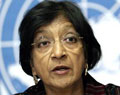
UN High Commissioner for Human Rights Navi Pillay has urged the international community to focus more of its energies on North Korea and lent her support to calls for an “in-depth inquiry” into the crimes committed by Pyongyang.
“We have only had glimpses of this terrible system from those who do succeed in getting out, but what we do know should compel the international community to action,” High Commissioner Pillay said Monday. “For this reason, I believe it is time the international community took a much firmer step towards finding the truth and applying serious pressure to bring about change for this beleaguered, subjugated population of twenty million people.”
Pillay expressed the UN’s disappointment at the state of human rights in North Korea a year after Kim Jong Il’s death, noting that the expectations harboured by many have been almost entirely dashed.
“There were some initial hopes that the advent of a new leader might bring about some positive change in the human rights situation in DPRK,” she said. “But a year after Kim Jong Eun became the country’s new supreme leader, we see almost no sign of improvement.”
“I am also concerned that, at the international level, the spotlight is almost exclusively focused on [North Korea’s] nuclear programme and rocket launches,” she went on. “While these, of course, are issues of enormous importance, they should not be allowed to overshadow the deplorable human rights situation in [North Korea], which in one way or another affects almost the entire population and has no parallel anywhere else in the world.”
Focusing on North Korea’s infamous system of five political prison camps, she added, “The camp system not only punishes individuals for legitimate, peaceful activities such as expressing dissenting opinions, it also involves rampant violations, including torture and other forms of cruel and inhumane treatment, summary executions, rape, slave labour, and forms of collective punishment that may amount to crimes against humanity.
“Living conditions in the camps are also reported to be atrocious, with totally insufficient food supplies, little or no medical care and inadequate clothing. One mother described to me how she had wrapped her baby in leaves when it was born, and later made her a blanket by sewing together old socks.”
Following on from unanimous votes in favour of resolutions highly critical of North Korean human rights in both the UN Human Rights Council and General Assembly, Pillay said now is the time to take additional action.
“For years now, the Government of [North Korea] has persistently refused to cooperate with successive Special Rapporteurs on the situation of human rights in [North Korea] appointed by the Human Rights Council, or with my Office,” the High Commissioner said. “For this reason, and because of the enduring gravity of the situation, I believe an in-depth inquiry into one of the worst, but least understood and reported, human rights situations in the world is not only fully justified, but long overdue.”







