

Cadres of collective farms have been
selling land usage rights for state-owned farming land to individuals in
exchange for thousands of dollars in bribes, Daily NK has learned.
“Collective farm officials are
forging documents to convert state property into non-farming land and cashing in on it,” a source in South Pyongan Province told Daily NK on Thursday.
“In the case of South Pyongan Province, to have 300 pyong (991 square meters)
of land transferred, you need 1,000 USD in bribes, and the property is used for
individuals to build homes.”
This trend was confirmed by a source in
North Pyongan Province as well, but as of the time of writing Daily NK has not
verified if this trend is nationwide or contained to the provinces of North and South
Pyongan.
Most paying bribes in exchange for land on
which to build homes are the donju, or “money masters,” the newly affluent
middle class; foreign currency-earning enterprises are the other group eager to
gobble up swathes of land, as the source put it. “They pay the management
committee head of the collective farm about 600 USD, the work unit head roughly
200 USD, and cadres from the provincial department of land supervision around
200 USD to secure 300 pyong to build their homes,” she explained.
Then, the management head and work head
unit–their pockets adequately lined– confer, devise a strategic plan, and
report 300 pyong of land to the supervisory department as being barren and
unviable for agricultural use. Next, with palms sufficiently greased as well,
the affiliated supervisory official waits a few days before ultimately stamping
his or her approval on the requisite documents to appropriate land for
residential use.
“When state homes are not being provided,
even if people are caught for paying bribes and building homes on land they
have bought, it doesn’t create any problems–so it’s permitted with tacit
consent,” the source explained.
In the North, the state holds official
ownership of land and residences, while residents merely hold usage rights; developments like this reappropriation of land, however, illustrate
that–for a significant cost–residents are increasingly maintaining de facto ownership in many realms of today’s North Korea.
Near the West Sea of South Pyongan
Province, some hundreds of state enterprises are engaged in foreign- currency
related businesses engaged in trade with China. Using the wealth they have
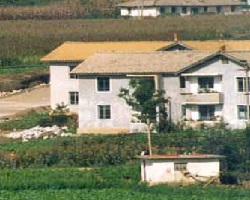
accumulated through these transactions, they put up luxury homes nestled in quiet farming
areas to escape the city and its unappealing apartment accommodations, the
source said, noting, “These individual homes or duplexes built around farming
areas near the West Sea in South Pyongan Province are incomparable with
state-provided homes.”
Bucolic life offers another perk: less
surveillance. “By living in the farming areas, you can– to some extent– evade
direct surveillance from the State Security Department and other law
enforcement agencies,” the source said, adding that the countryside also makes disproportionate socioeconomic situations less glaringly obvious than in more densely populated areas.
Besides all this, she concluded, “the advantageous thing about real estate is
that if their business endeavors fail, they can just sell off their property to make
money.”









