

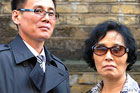
Ahead of North Korea’s appearance before the UN Human Rights Commission as part of the Universal Periodic Review (UPR) on December 7th, two defectors have been travelling in Europe to spread the word about the scale of human rights abuses in their former homeland.
Jung Guang Il and Lee Ok Suk both suffered horrendous torture at the hands of the brutal North Korean security apparatus, and on Tuesday they were at Portcullis House in London to testify to it at an event organized by Christian Solidarity Worldwide (CSW) and hosted by Baroness Cox of Queensbury along with Gary Streeter, MP.
“Both Jung Guang Il and Lee Ok Suk have experienced suffering and deprivation on a scale that we cannot begin to imagine,” Tina Lambert, the Advocacy Director for CSW pointed out in advance of the hearing.
Both defectors’ stories are indeed hard to conceive of. Jung was arrested and accused of being a spy in 1999. “I didn’t see it coming,” he told The Times in an interview the day before testifying, “North Koreans hear whispers about the gulags. But only that the people who disappear into them never come back.”
Over the following months, Jung was hung from a wall by a rope which was also securing his hands behind his back, in a room with no light, until he gave a false confession in order to bring his ordeal to an end. He says that during the ordeal he lost almost half his body weight.
Lee, meanwhile, was arrested for religious offenses. As a result, she had her nails pulled out one by one, followed by her lower teeth, and water with hot chilli pepper in it was put up her nose. When she failed to give the details of people she had converted to Christianity, she was sent to a reeducation camp for four years, where she suffered from severe malnutrition and the constant fear that revenge would be visited upon her family by the authorities.
The harrowing testimony of the two is designed to pile the pressure on North Korea ahead of its UPR next month. In its submission to the UN Human Rights Commission in advance of the UPR, North Korea denied the existence of human rights problems in the country, and pointed to “the U.S.’ hostile policy” and “Anti-DPRK campaigns including adoption of ‘human rights resolutions’ at the United Nations” as the two main barriers to its “protection and promotion of human rights.”
Therefore, Lambert explained, “Their testimony comes at a crucial time… we call on the international community to recognize the gravity of the human rights violations taking place and respond by supporting the call for a Commission of Inquiry by the United Nations to investigate crimes against humanity in North Korea.”







