
On the 26th, democratic activists met together to discuss ways to democratize the two dictatorial countries North Korea and Burma.
This is the first time activists have gathered in an organized forum to discuss the issue of democratizing North Korea and Burma. These representatives believe that North Korea and Burma have the commonality of a military dictatorship and desire to include the two countries as part of Asia’s democracy.
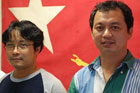
On the 22nd, I went to visit the National League for Democracy (NLD) office in Korea. In a small office no more than 16 square meters, I met Zaw Moe Aung, a manager of Burmese National League and Kyaw Swa Linn the planner.
Movements for Burma’s democracy began in 1988. Presently, the NLD leads the fight for Burma’s democracy. Even today, tens and hundreds of thousands of NLD activists battle to win the fight for democracy in Burma. The NLD’s Korean office was established in 1998.
13 years ago, this group of activists left Burma fleeing from the threat of imprisonment for proclaiming democracy in their own country and came to South Korea where democracy had taken stance. These activists who arrived in Korea in 1994 have organized a variety of movements for Burma’s democracy and even held a demonstration in front of the Burmese Embassy petitioning for the release of NLD’s General Secretary Aung San Suu Kyi.
They revealed their position on the recent forum, “We hadn’t considered North Korea’s situation or deliberated many proposals on North Korea’s democracy. However, from the perspective of Asia’s democracy, democracy must be achieved not only in Burma but North Korea also.”
Though these activists have been fighting for Burma’s democracy for more than 10 years and hence are veteran leaders, they stressed the uniqueness of North Korea’s regime but displayed a cautious position on democratic strategies.
Mr. Moe Aung said, “At the moment we are focusing on democracy in Burma but in future, we will need to consider North Korea’s issues to develop democracy in Asia.”
He said, “Burma and North Korea’s democratization is close at hand but unfortunately it is extremely difficult to create a specific proposal that will solve the issue” and “However, if we put out minds together on democratizing Burma and North Korea through the upcoming forum, I believe we will be able to deduce a realistic proposal.”
They argued that it was difficult to engage in regular democratic movements in both Burma and North Korea, and stressed the important role of international volunteers who will fight for democracy of the two countries from a third party.
“As military dictatorships, the military in both Burma and North Korea control and block the eyes and ears of the people. Moreover, the military has all the power and so nothing gets recognized unless the military is involved” said Mr. Moe Aung and added, “Under these circumstances, Burma and North Korea are similar and in order to change, foreign assistance is critical.”
Although control is rigorous and strictly regulated in both military dictatorships, the activists agree that the situation in North Korea is significantly worse. Anti-government movements can be organized in Burma whereas you cannot conduct any democratic movements in North Korea. Further, they asserted that foreign information had to be imported into North Korea in other to spread the notion of democracy.
“The international society must inform North Koreans on their real situation. Though this may seem like a small act, contact with this kind of information will incite change amidst the North Korean people” he said, proposing a way to introduce democracy into North Korea and encouraging greater active participation from foreigners.
She added, “We predict that Burma’s military dictatorship will collapse within the next 5 years. However, it will take much longer for North Korea” and asserted, “North Korea is a country where the dictatorship was handed down by descent from Kim Il Song to Kim Jong Il and so it is not a country that will be easily changed. Rather than targeting change from the inside, change must be provoked from the outside.”
He said, “We could anticipate change in North Korea if we could distribute written materials targeting the people and educating them. But this is not possible in North Korea” and “Under the present conditions, it is important to encourage change little by little through action such as sending radio frequencies.”
He added, “I look forward to the future when South and North Korea unifies. However, on looking at the North Korean regime, I think it will be different to achieve this in a short period of time” and “It has taken us more than 10 years of endless democratic movements but we stood firm. Through these small steps, I believe North Korean democracy will multiply.”
Regarding the meeting in April between North Korea and Burma to normalize relations, “They are dangerous countries, further if two dictatorial nations hold hands it will be extremely dangerous” and expressed her concern, “I am aware that North Korea who possesses nukes has discussed sharing nuclear armaments with Burma. If this occurs, the people in both counties will be in grave danger.”