

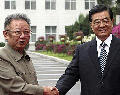
In an opinion piece in today’s Los Angeles Times, two senior U.S. experts on North Korea and China allege that Pyongyang has decisively shifted its focus from seeking relations with the U.S. towards firming up and building relations with China.
Robert Carlin and Prof. John W. Lewis, both of Stanford University, cite unnamed Chinese officials as revealing that during Kim Jong Il’s May, 2011 trip to China, he agreed with the leadership in Beijing “not to ‘make trouble’ (as the Chinese described it to us) in the short term, presumably meaning no deliberate military provocations, no third nuclear test and no launch of another ballistic missile.”
“Beyond that, the talks ended in a compromise that neither side found entirely satisfactory,” the two authors contend, saying, “Kim came away with less aid and a smaller Chinese commitment of support than he had sought.” China also promised “increased access” to its capital and technology, and to work closely with North Korea on joint economic zones along the shared border between the two countries.
One of the major consequences of the deal, they claim, is that there is unlikely to be any trouble on the Korean Peninsula in the “near to medium term.” This is good, they note, but only “as long as it is understood that such tranquility will also provide a veil for the North’s continuing pursuit of nuclear weapons and increasingly sophisticated delivery systems.”
But above all, the two experts claim that this most recent shift towards China is not one of North Korea’s well-documented “routine oscillations” between regional powers. In the early and mid 2000s, North Korea was willing to shun China in order to work on relations with the U.S., they say, but that is no longer the case. Whereas on the October 25th, 2000 50th anniversary of China’s entry into the Korean War Kim Jong Il was in Pyongyang meeting with then Secretary of State Madeleine Albright in Pyongyang, now he would be sure to choose China.
“There was considerable momentum behind the North’s strategy for engaging the U.S. in past negotiations,” they conclude. “That is no longer the case, with consequences we have only started to feel.”







