
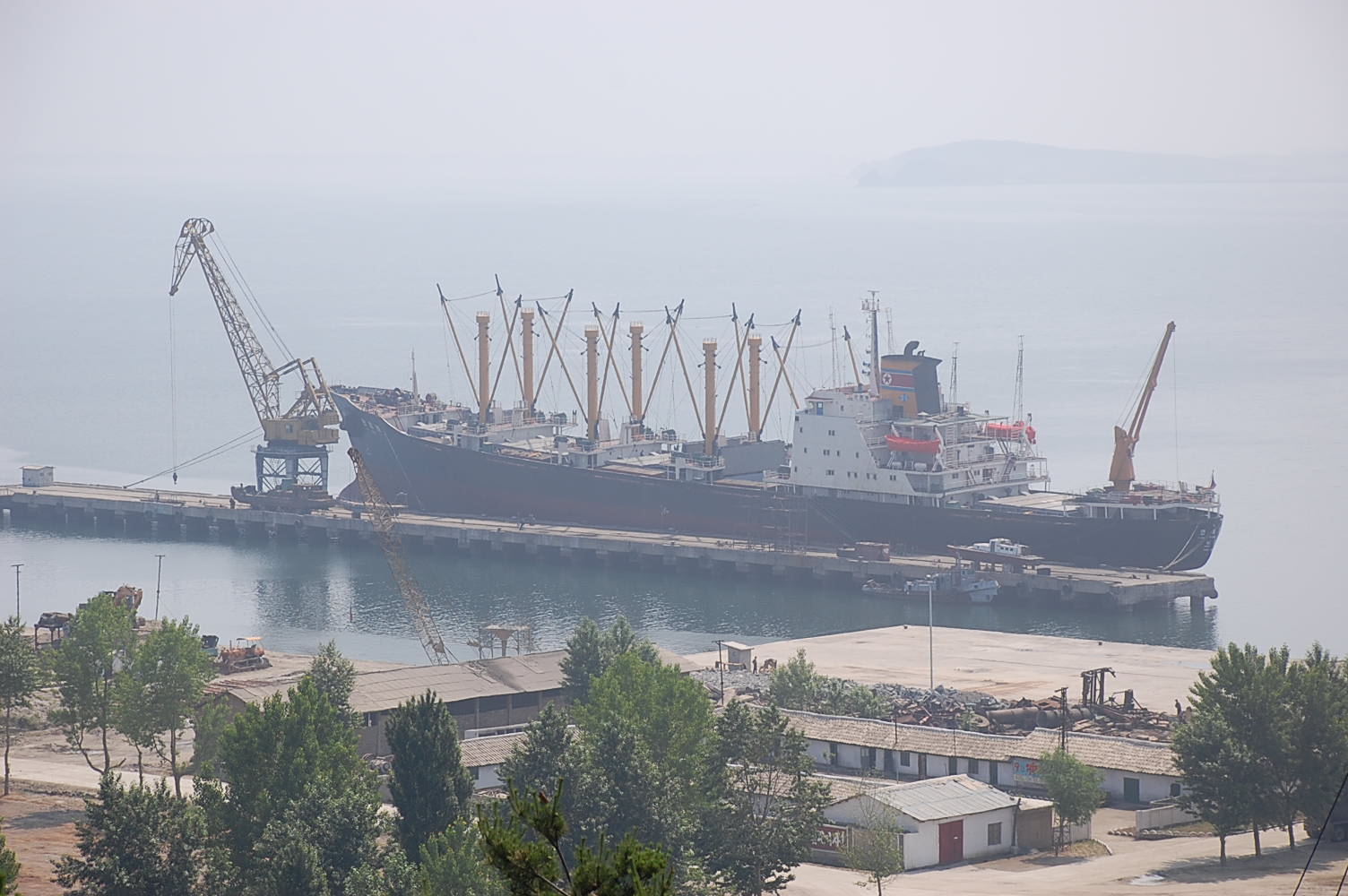
Liaoning Province-based Chinese trading companies have recently established branch offices in Shandong Province to engage in seaborne trade between Dalian and Longku in China and Nampo Port in North Korea, a reporting partner in China told Daily NK on Friday.
Over the past three years, Chinese companies have faced difficulties in conducting trade outside their home regions due to the COVID-19 pandemic. After the Chinese government lifted disease control restrictions recently, these companies are now more free to conduct activities in other areas.
The reporting partner, speaking on condition of anonymity, told Daily NK that Chinese people with registered businesses and a history of trade with North Korea can take part in seaborne trade with North Korea in Shandong Province relatively easily.
Given the fact that these trading companies cannot take part in seaborne trade with North Korea without Chinese government permission, the reporting partner said that the establishment of branches in the area may be in consideration of Chinese government efforts to expand trade with North Korea.
Most ships leaving the ports of Dalian or Longkou for North Korea are large freight vessels, so companies can conduct larger deals than they could from Liaoning Province.
However, it is not a simple matter for trading companies previously active in China’s northeast to shift their activities southward.
Given Liaoning Province’s close proximity to North Korea, logistical expenses are cheap compared to Shandong Province. The companies must also face a rise in investment-related expenses because they have to find new purchasing and distribution routes.
Nevertheless, Liaoning Province trading companies are moving to Shandong Province even if they have to take on the extra costs, the reporting partner told Daily NK.
SEABORNE ROUTES OPEN NEW OPPORTUNITIES FOR ILLEGAL TRADE
The growth in seaborne trade between China and North Korea means that items under international sanctions may be entering North Korea.
The international community can easily observe land-based bilateral trade through Dandong, so most of the items being traded there have included food and other daily necessities that are not under sanctions.
Seaborne trade, however, provides the opportunity for North Korea and China to easily trade sanctioned items because ships carry a great amount of goods all at once. The two parties can also trade goods under sanctions through ship-to-ship transfers while at sea.
In a recent email interview with Daily NK, Troy Stangarone, senior director and fellow at the Washington DC-based Korea Economic Institute (KEI), said that there are limits to how much cargo can be unloaded in Nampo, which means that rapidly increasing trade through the port will prove difficult unless additional storage facilities are built. Stangarone also noted that there are likely certain items that can be better shipped by sea than through train or truck.
In short, the North Korean authorities may believe it is better to import certain goods, such as refined oil products, by sea rather than overland.
Moreover, Nampo is North Korea’s leading port for state-led trade, so imports that go through the city could largely be those that are for the nation’s elite.
“Nampo is essentially Pyongyang’s harbor,” Stangarone told Daily NK. “[Reports about expanding trade through Nampo] suggests that [the North Korean authorities] could be focused on quickly supplying even more goods to the country’s elite, rather than items required by the entire nation.”
Translated by David Black. Edited by Robert Lauler.
Daily NK works with a network of reporting partners who live inside North Korea. Their identities remain anonymous due to security concerns. More information about Daily NK’s reporting partner network and information gathering activities can be found on our FAQ page here.
Please direct any comments or questions about this article to dailynkenglish@uni-media.net.