

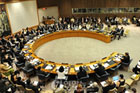
The UN committee charged with overseeing the implementation of sanctions against North Korea has said it will persist in trying to overcome Chinese resistance to new recommendations which call for the tightening of sanctions against Pyongyang.
The Chinese are reportedly refusing to allow the publication of a report which calls the North Korean uranium enrichment program (UEP) a fresh violation of UN sanctions resolutions and demands that the sanctions be tightened in response.
The recommendations go against China’s general position of refusing to strongly condemn North Korea while calling for the re-starting of the Six-Party Talks, which it chairs.
“We’re looking at the recommendations,” the chair of the committee, Portuguese UN Ambassador Jose Filipe Moraes Cabral told reporters after a meeting yesterday in which the report was discussed. “We will see how we treat it and what we do with it in due course.”
“You have to discuss these things in depth and give it time and be patient and eventually arrive at a decision based on consensus,” he added.
However, without consensus between Security Council members, it will be hard to achieve anything of substance.
The report’s recommendations are based on evidence obtained by Siegfried Hecker, the American nuclear scientist who was shown North Korea’s uranium enrichment site in the middle of the Yongbyon nuclear research facility in early November.
According to AFP, the unpublished report quotes Hecker as saying that the North Koreans must have had foreign assistance to build the surprisingly advanced UEP facility. While this has yet to be publicly confirmed, in an article published by Physics Today shortly after last year’s trip, Hecker said of the enrichment centrifuges at the site, “We still don’t think they have the ability to make their own high-strength steel and high-strength aluminum alloys, so they must have procured that from somewhere else.”
“Most likely, they put it together themselves domestically,” he added, “but they were able to get the components (ring magnets, bearings, vacuum valves, and so forth) in the international market. And these components and materials are on the export control list, but it looks likely they were able to work around the export control restrictions.”
Chinese opposition to the report is said to be officially predicated on the notion that Hecker’s observations have not been independently confirmed.







