

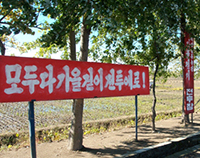
North Koreans received a “Harvest Full
Mobilization Order” in September for forty days of collective farm harvest
operations followed by “Fall Land Management Full Mobilization” work, Daily NK
has learned.
“‘Land Management Full Mobilization’ started
early last month immediately after the end of farm support operations,” a
source in North Hamkyung Province reported to the Daily NK on November 3rd.
“Residents have been mobilized for two-hour long waterways cleanup starting at
5a.m. and laborers are working on construction sites managed by businesses for
waterways, roads, and levees.”
“Barefoot residents have to enter the frozen
creek in the Sunam area of Chongjin City in the early morning to scoop out sediments with shovels
and buckets. It is difficult to even breathe due to the foul smelling sediments
flowing out of the city drains, so people are utterly exhausted by having to
carry the deposits on their backs,” he added.
According to the source, this creek has nearly no streamflow due to the lack of water and the stench from the
sewage piling up from drains is severe. Therefore, residents are being
mobilized for an extensive waterways construction project to pull in water from
a stream in Soosung, continuing the never ending series of mobilized tasks from last month.
North Korea designates October as the
annual season for “Fall Land Management Full Mobilization” and carries out
litter removal from waterways, construction of levees and roads, and planting
trees and grass. The source explained that during this time, county and
district People’s Committees supervise, and once every inminban [people’s unit]
and enterprise is given a work assignment, students and women of each class,
and factory workers are all put to work.
“Authorities are propagandizing the work as
a ‘patriotic commitment,’ but as the work stretches over one to two consecutive
months, the number of non-participating families is growing,” the source
asserted. “Families that do not fully mobilize are called to the corresponding police
stations, and there are even cases of heads of enterprises being locked up in
detention houses under the ‘10 days confinement law’ for careless dispatch of
personnel.”
The source reported that despite the
propaganda of North Korean authorities, as residents enter cold waters to dig
riverbeds and haul out trash, they are complaining that regardless of
“patriotic this” and “commitment that”, the current labor is worse than the
forced labor during the Japanese colonial period, an oft-employed phrase by residents to express their disgruntlement. However, there are also attitudes that “in order to avoid later
disadvantages, there is no choice but to participate.”
In April 2012, Kim Jong Eun’s speech in
front of Party and management officials, publicly announced that it would
require focused laborious work “to bring upon a revolutionary change to land
management systems that meet the needs of a strong and prosperous socialist
nation.”
The statement included information about the need to brilliantly prepare
Pyongyang as a capital of revolution–an international city of impressive
grandeur and beautiful scenery. However, the source critically noted that
without facilities and equipment, and limited to moving stones and dirt with
shovels and buckets driven by manpower, there was no doubt that levee construction
would prove to be faulty.









