

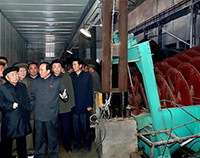
Workers at Hyesan Mine, located in the
border region of Yangkang Province, reportedly received special ration
allowances in honor of Kim Jong Eun’s birthday, but the unexpected distributions were not extended to any North Korean residents unaffiliated with the
mine.
“Most children received sweets on January
7th as a gift ahead of the Marshal’s [Kim Jong Eun] birthday,” a source
in Yangkang Province reported to Daily Nk on January 8th. “Other than that,
people didn’t even get a single bottle of alcohol, but those workers at Hyesan Mine
received 5kg of sugar and 1kg of cooking oil.”
As previously reported by Daily NK, most residents looked forward to a holiday and perhaps special food rations on the young leader’s birthday, but instead spent the day fulfilling compost quotas handed down by the authorities. “Even though it was the Marshal’s birthday
everyone was out collecting manure.” she explained.
She added that a fair number of people were willing to suppress complaints about the mobilization, expecting at least a small perk to mark Kim Jong Eun’s birthday. However, as the day passed, devoid of any supplemental gifts, residents debriefed among themselves, saying, “Mobilization aside, if they had at least given us one bottle of
alcohol for the men , they would have really enjoyed it after coming out from being
in the cold working tirelessly.”
In the case of workers at Hysean Mine, however, the day passed not only with benefits, but exemption from gathering manure. The source attests that this is fairly
standard practice: laborers at the mine receive regular salaries and food
rations each month with almost clockwork precision–a stark contrast to the situation of
workers at the majority of other enterprises in the North.
Hyesan Mine, located in the Masan District of
Hyesan City, Yangkang Province, emerged as North Korea’s first copper mine in
2010, galvanized by investments pouring in from Chinese enterprises, which the source
asserts as reason behind the steady stream of wages and rations provided to the
affiliated workers.
These wages are exorbitant by North Korean
labor standards. “Last month there was a worker who received 400 RMB; those who
did particularly arduous drilling work even got 500 RMB,” adding that their
rations typically included sugar, rice, and cooking oil. As of January 8th, 1
RMB traded for 1300 KPW in the North Korean markets; rice cost 5000 KPW per kilogram.
For residents outside Musan’s jurisdiction, the compost mobilization brings with it a new issue amid the general unceasing onslaught ordinary families in North Korea face every day. “Because every last person has been
mobilized to collect manure, people are worried about getting enough food to
eat,” she explained, expressing concern about the lack of time to do business necessary to provide for one’s family. But then you see those Hyesan
workers get money and benefits no matter what, so people talk about it a
lot. There’s a lot of interest about what goes on there”
Residents are well aware of the considerably favorable conditions that lie just across the border in China. “Look how right over the [Amrok] river people have
all that they need; we’ve got nothing,” many say, according to the source, adding, “No wonder people defect!”
She goes on to explain that most residents in the region are under the impression that “in order to eat, you need
to be involved somehow with the Chinese.” “The state can only make paltry offerings, if at all, but at a joint company, ration provisions would stabilize so it seems
that things can’t help but move in that direction,” she
concluded, expressing a sentiment shared by many of North Korea’s residents.









