

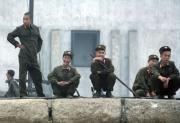
In a surprising and unheard-of move, a substantial fine was recently handed down to officers at a Chosun People’s Army base found guilty of violating military-civilian relations, suggesting the practical implementation of measures to combat the increasingly unruly behavior of soldiers.
In the case, officers under the battalion commander of a 10th Corps base in Yangkang Province were served with fines of 10,000 to 30,000 won each.
Speaking with Daily NK yesterday, someone with inside knowledge of the base in question explained, “In a mass meeting of the base up to and including families, officers under the battalion commander were handed the financial punishment for the misconduct of paying off a restaurant tab with rice stolen from civilians.”
This, the source noted, “is the first time a financial punishment has been imposed in place of demotion or some other form of disciplinary action.”
Conventionally in North Korea, minor violations have always led to a report to the individual’s workplace or unit followed by a self-criticism session, while criminality earns the offender prosecution and imprisonment.
That being said, North Korea is now a country muddling through via a corrupt form of ad hoc capitalism, where the imposition of fiscal penalties is not uncommon and bribery is endemic, so as such it is not a surprising step.
“Usually offenders go through self-criticism and if that does not produce signs of improvement they are sent to military jails,” the source said, explaining the ordinary disciplinary process. However, analyzing the new approach, he went on, “The adding of a financial penalty can be interpreted as imposing a genuine disadvantage on offenders while preventing further crimes.”
Nevertheless, one defector who graduated from Kim Il Sung National War College said he was shocked by the news, commenting, “I have never heard of financial punishment in the military. In North Korea you are only fined when you cause harm to the state in some way in a factory or enterprise, and at those times you are prosecuted as well.”







