

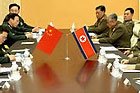
In the latest in a long line of opportunities to show off his apparent health and supposed array of powerful friends, Kim Jong Il has held a meeting with Chinese defense minister Liang Guanglie, according to North Korea’s state media.
Following hard on the heels of last month’s visit to Pyongyang by Chinese Premier Wen Jiabao, this latest meeting seems designed to signal a strengthening China-North Korea alliance. Liang arrived in Pyongyang on Sunday as part of a three nation tour which is also set to include Japan and Thailand.
According to a report released by the Chosun Central News Agency (KCNA), Liang “courteously conveyed the regards” of Chinese President Hu Jintao to Kim. Talks between the two were apparently “cordial” and “friendly.”
China’s Xinhua News Agency reported that Kim Jong Il told Liang during the meeting, “Our countries’ friendship is a treasure that will be never broken, which has been developed by our leaders through historical trials.”
Whether or not the visits by high level Chinese officials really signal a developing alliance is questionable, however. In a regular seminar this week, Hwang Jang Yop, President of the Committee for Democratization of North Korea, was dismissive of what he called Kim’s “ostentatious display,” saying, “We cannot tell whether or not their alliance is getting stronger by just watching what they are doing. We do not even need to keep watching, because North Korea has always said that its friendship with China is unchangeable, and communications between the two countries’ high officials have been more intimate in the past than they are now.”
Regardless of which, the presence at the meeting of Kang Sok Ju, North Korea’s first vice foreign minister, is noteworthy. Since Kang is widely expected to be prominent in the December 8th visit to North Korea by U.S. point man on North Korea Stephen Bosworth, his presence at this week’s meeting suggests that nuclear weapons and Bosworth’s visit were both on the agenda, says Yonhap.
Indeed, three times Chinese Defense Ministers have visited Pyongyang in the 2000s, and each was at a decisive turning point in North Korea-U.S. relations.
When former Defense Minister Chi Haotian visited North Korea in October, 2000, the visit to Pyongyang of then Secretary of State Madeleine Albright was discussed.
More negatively, in April, 2006, when former Defense Minister Cao Gangchuan visited, North Korea was in the process of rejecting the Six-Party Talks and demanding that economic sanctions over it be lifted.
During Cao’s visit, Kim Jong Il denied him a meeting, and after his departure North Korea took an even harder line by firing missiles on July 5, and conducting its first nuclear test on October 9.
However, this time, since both North Korean and Chinese state media have praised the meeting and Kim agreed to meet with Liang personally, it seems that agreement on the visit of Bosworth or how to proceed in nuclear negotiations may have been reached.







