
Daily NK recently conducted an email-based interview with Dr. Chan Young Bang, who is a former economic advisor to Nursultan Nazarbayev, the first president of Kazakhstan, and the Founder and President of KIMEP University and Principal Investigator at the DPRK Strategic Research Center. The interview focused on a range of issues confronting North Korea, including food shortages, trade with China, and prospects for economic reform. Dr. Bang’s latest book, Transition beyond denuclearization – A bold challenge for Kim Jong Un, was published by Palgrave Mcmillian in 2020.
Daily NK (DNK): North Korea is facing a myriad of challenges in 2023, including what some experts say is the worst food insecurity since the Arduous March and continued international sanctions that make it difficult to conduct imports of necessary goods. Starting several years ago, the country began setting up state-run food shops to improve the supply of food to ordinary people. Do you think a state-led solution, as opposed to a market-led solution, is the best way to resolve the food shortages?
Dr. Bang: The DPRK is currently facing serious shortages of food supplies, the worst since the Arduous March of the 1990s. To feed its population, according to statistics from the UN’s Food and Agriculture Organization and South Korea’s Rural Development Administration, the country needs at least 5.95 million tons of grain each year. In 2022, estimates show that North Korea produced 4.51 million tons, creating a shortage of nearly 1.5 million tons. In other words, North Korea has enough grain to last nine months, not a day more.
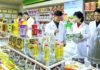
In an attempt to address the food shortages, Kim Jong-un has set up state-run food shops, reflecting a false belief that the shortages are a consequence of a distribution issue, when the main issue resides in the low productivity of the agricultural sector for the past decade. Changing the way food is distributed around the country, from farmers to state-run food shops in Pyongyang, is merely an illusion. The regime is trying to delude and hide the fact that production is the main issue at hand.
There are four compelling reasons for this chronic low productivity. First, the country lacks the machinery and fertilizers necessary for farming; sanctions have depleted the foreign currency needed to import such necessities. Second, the state owns all the means of production and the inefficiency of state management suppresses productivity. Third, there are no material incentives for state-employed producers, only ideological coercion. Fourth, recent weather conditions – floods and storms – have severely damaged the agricultural sector.
The food shortages the DPRK is facing are a recurrent concern for the regime. At the 9th Congress of the Union of Agricultural Workers of Korea in January 2023, Kim Jong-un demanded that the farmers stop selling on the black market and accused them of showing “anti-socialist” tendencies.
A good example of poor responses of the regime to this critical issue concerns the production of rice. The state pays only one-third of the market price for rice, which pushes producers to sell their products in local markets, and a bare minimum to the state.
The situation has led to a trend witnessed in all socialist countries prior to their reforming or collapsing. In socialist Vietnam, private producers working 5% of the arable land area provided up to 75% of the food consumed in the country. In the DPRK, there has been a similar pattern with the proliferation of Sotoji, illegally operated private farms located in mountainous areas, which in 2007 produced 750,000 tons of grain, representing 20% of the total production.

These issues illustrate the fundamental flaws of socialism, but the DPRK’s food shortage is being compounded by further issues. The country is under strict UN Security Council sanctions because of its nuclear weapons programme, preventing trade and forcing the regime to deplete its foreign currency reserves, thus hindering the import of food, agricultural products and fuel.
The chronic food shortages faced by the DPRK in the past decade are the result of a productivity issue, not an issue of distribution, an inherent defect of the socialist system. In order to solve the problem, the regime has no choice but to transform into a market socialist economy, allowing for privatization in the agricultural sector. The present system is faulty, inefficient and must be drastically changed.
DNK: The compound effects of the 2017 UNSC sanctions, the DPRK’s response to the COVID-19 pandemic, and the Russian war in Ukraine have crippled the North Korean economy and precipitated a state of uncertainty for the regime. According to data from China Customs, North Korea has increased its trade with China over the past month. What would be the consequences of China engaging in further illicit trade with the DPRK?
Dr. Bang: The UNSC sanctions of 2017 have had a severe effect on DPRK exports of strategic items, including important commodities and products such as coal, iron, seafood, textiles and human resources. Under the sanctions, these items, all dependent on North Korean state enterprises, were banned from exportation, putting the country in a dire economic situation. This was exacerbated following the complete border shutdown in response to the COVID-19 pandemic.
For the DPRK, illicit trade provides desperately needed revenue. As soon as the border reopens, it is likely that Pyongyang will try to extend illicit trade with companies in China, its main trading partner. However, there is no solid evidence that the Chinese central government is inciting illegal trading activities with the DPRK.
One of President Xi Jinping’s main objectives is to become a respected world leader and turn China into a preeminent superpower. Any illicit trade will lead to significant sanctions. Therefore, supporting illicit trade with North Korea has a prohibitively high cost for Beijing, considering that the U.S. is undertaking an economic containment policy against it. Such an action from the Chinese side would constitute a blatant breach of UNSC sanctions and serve as a pretext for the U.S. to galvanize its containment policy.
Additionally, it is difficult for the DPRK to hide its illegal trade because the U.S., South Korea, Japan and others are able to constantly surveil and monitor the waters around the country, negating the effectiveness of sailing ships under flags of other countries to hide their identity. The cost of illegal trade has skyrocketed for the DPRK. Smuggling with entrepreneurial merchants will not have a significant impact on North Korea’s economic well-being.
North Korea may see hope in the re-opening of its border, but there is no light at the end of the tunnel for Kim’s regime.
DNK: Some argue that South Korea’s economic development experience provides a roadmap for North Korea’s economic development. Based on your experience, do you believe South Korea’s experience is an apt guide for North Korean economic development? If unification, or at least a federal system were to be implemented between the two Koreas, would a South Korean-led economic development program be best suited for implementation in North Korea?
Dr. Bang: History reveals that, without exception, all former socialist countries which have achieved economic development have had to introduce market-oriented economic reforms. There are three different models of economic change which could be applied to the DPRK.
The first model is that which was followed by countries of the former Eastern Bloc and Soviet Union, such as Kazakhstan. These countries transformed into fully-fledged market economies and completely abandoned the socialist ideology. In this model, privatization on a large scale occurs and the mechanisms of the central planning and rationing system are dismantled. Without exception, countries which adopted this model have been able to break away from totalitarianism. Some have even embraced fully-fledged democracy.
A second model which the DPRK can adopt is that practiced by China and Vietnam: market socialism. While political control remains in the hands of the communist party, the class-struggle ideology has been abandoned, and central planning and the rationing system were dismantled. These countries partially privatized the means of production and abandoned totalitarianism in favor of authoritarianism, radically changing their economies and seeding rapid growth.

The third model – unification with another state – has only been followed by one socialist country: the German Democratic Republic (or East Germany). When it comes to the DPRK, if such a step were to be taken, it would not result in a smooth transition. At this point, the absorption of North Korea by the South would be bloody, either leading to a full scale war or hostile takeover due to the collapse of the regime. It would create acute instability on the Peninsula and across Northeast Asia. Prior to any project of reunification, a currently impracticable path, the two Koreas must be able to narrow the gap between their people’s incomes as much as possible. More than 70 years have passed since the onset of the Korean War, which led to the divide. The two countries are at this point extremely different and there can be no stable and peaceful reunification as long as the economy of the South is 55 times larger than that of the North.
Under its current ruling ideology euphemistically referred to as Juche, or self-reliance, the DPRK can neither emulate nor adopt the South Korean model of development. South Korea, China and Vietnam have integrated with the global economy, and have thus experienced the benefits of technological transfer, acquisition of managerial knowhow and inducement of foreign investment. Isolated countries including the DPRK cannot develop without radical change because they can neither adopt the innovations of developed countries, nor induce foreign investment needed to modernize their economies.
To achieve rapid economic development, North Korea must implement radical political and then economic reform, away from its dysfunctional Juche based system (a so-called scientific and sublimated form of socialism), ending the hostile policy which is fundamental to Juche, and allowing for the creation of a market economy, special economic zones and other policies crucial to success.
Rather than following a path similar to that taken by the South in the 20th century, the DPRK should adopt a model of economic development inspired by the Chinese and Vietnamese approach, this being market socialism. North Korea has the potential to achieve the most rapid economic development of any country in history owing to its prime location, surrounded by prosperous neighbors, and highly strategic in terms of shipping routes. Additionally, the country has significant industry potential. Logistics, fisheries, tourism, and the IT industry show particular promise, and the labor force is both well-disciplined and low cost: a strong encouragement to investors from worldwide companies.
DNK: The Yoon administration has taken a harder stance toward North Korea than the previous Moon administration. What areas do you agree and disagree with in regards to the Yoon administration’s current stance on North Korea? Why do you think that South Korea should lead the Six-Party Talks for the denuclearization of the DPRK, as you stated in your latest article for the South China Morning Post?
Dr. Bang: If the Yoon government wishes to be effective in convincing North Korea to denuclearize, it should lead the Six-Party Talks held in collaboration with the U.S., China, Japan, Russia and the DPRK. President Yoon must lead these talks for four fundamental reasons.
Number one – the U.S. does not have any viable strategic plan to achieve denuclearization of the Peninsula. All denuclearization policies adopted by previous U.S. administrations have singularly failed.
Number two – the U.S.’s overriding policy objectives in the region differ from those of South Korea. For the U.S., denuclearization of the DPRK is an end unto itself, but for South Korea, the establishment of permanent peace and stability on a nuclear-free Peninsula is essential. Moreover, the DPRK’s nuclear weapons constitute a peripheral regional threat to the U.S., but are a life-and-death issue for South Korea.
Number three – to achieve denuclearization, it is important to understand what the nuclear weapons program means to the DPRK. It is a strategic asset, essential for the country’s survival. Therefore, to succeed, any denuclearization deal has to ensure North Korea a better chance of survival as a non-nuclear state. The offer must take the form of a package deal the DPRK cannot refuse, and President Yoon is the only actor able to make such an offer. A package deal has to incorporate a combination of “sticks” and “carrots”, so that if the DPRK continues its nuclear weapons program, it would pay a prohibitively high price and endure devastating punitive measures. However, should the DPRK dismantle its nuclear weapons, stakeholders must guarantee the country a genuine chance of survival.
Number four – denuclearization cannot be achieved without the active participation of China. China is the only country which can wield credible “sticks” against the DPRK. To secure Chinese support for the deal, denuclearization must be accompanied by the realization of permanent peace, stability, and prosperity on the Korean Peninsula. Not only does the DPRK have to survive, it must also become economically prosperous, and needs to contribute positively to these aims. If a deal is to come to fruition, it will be contingent upon Chinese support; this means that once permanent peace and stability are established, U.S. ground troops must depart the Peninsula.
South Korea must be the largest provider of essential financial aid to the DPRK in the event of a deal being agreed upon because it stands to gain the most from North Korea’s development. Radical market-oriented economic reform, a peace treaty and denuclearization will not be enough for the DPRK to economically develop, so South Korea must provide monetary support which will enable 10% yearly growth. Unfortunately, the Yoon administration’s approach has so far been ineffective. The president’s so-called “bold and audacious initiative” exposed his limited understanding of what nuclear weapons mean to the DPRK. His approach was fiercely rejected: Kim Yo-jong, Kim Jong-un’s powerful sister slammed Yoon’s offer, calling it the “height of absurdity” and stating that “no one barters their destiny for a corn cake.” President Yoon must change his approach if he is to succeed within the timeframe of his presidency.
DNK: North Korea has long clamped down on the spread of foreign information inside its country and even restricts the spread of internal information, such as the prices of basic commodities like rice and corn. In recent years, the country has clamped down further on the consumption and spread of South Korean films and movies and, just this year, passed a law targeting people who use or spread South Korean-style speech with various punishments, including the death penalty. How do you view these developments and what can be done to improve North Korea’s stance toward South Korea and South Korean culture?
Dr. Bang: In order to survive, the DPRK must be able to effectively control, and if necessary crack down on, the diffusion of unwanted information. It is crucial that the regime prevents the dissemination of information detrimental to its power. Kim wants to preserve the myth that he was able to establish a workers’ paradise: a country where there is no alienation, where all people have guaranteed jobs, where there is free medicine and food security, distributed according to people’s needs. These attributes are considered the most important safeguards for the regime. Such features are, of course, not present. Within this paradigm, South Korea is being depicted as a country of inequality, poverty and mass exploitation. If someone is found to have used South Korean words, or even wears a South Korean hairstyle, they will be punished for attempting to spread what the regime would characterize as capitalistic poison. However, once the myth disintegrates, the regime will collapse.
The situation has not always been as harsh as it is today. During South Korean President Moon Jae-in’s tenure, the DPRK’s stance on outside information appeared to be softening, but has since regressed. Under President Moon, the leadership in Seoul began to establish good rapport with Kim Jong-un and to engage positively in cultural exchange, paying particular attention to inter-Korean family reunions.
The situation is radically different under President Yoon Suk-yeol. Since his inauguration, the president has taken a more aggressive stance towards North Korea, openly criticizing the DPRK’s military provocations and threats.
In the end, the continuation of cultural activities between the two Koreas is contingent upon the internal situation of the DPRK. The more dire the situation in North Korea, the more the regime will close to any sort of interaction with the outside world. Clamping down on the spread of information, punishing citizens consuming South Korean cultural products and so on, shows how desperate the regime actually is.
As long as the DPRK holds on to its hostile ideology, this horrendous state of affairs will continue. To a country in a state of war, peace is the worst enemy. Little can be done to improve the situation while the DPRK holds on to its nuclear weapons, rather than trading them for a bright future.
Please direct any comments or questions about this article to dailynkenglish@uni-media.net.