
[imText1]
Anticipating popular resistance to the establishment of a punishing ‘reunification tax’, a number of expert voices are now being raised in support of finding a way to build up a reunification ‘war chest’ through greater voluntary participation.
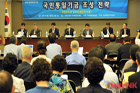
As part of this effort, a number of diplomatic and security experts gathered to discuss the issue at ‘National Unification Fundraising Strategy’ forum on August 17th.
“It is necessary for us to consider how to provide unification funds which can draw in voluntary participation,” asserted Doh Hee Yeon of ‘Too a Happy Unification’, the organizer of the event.
Doh put forward three ideas for discussion: ▲ developing unification financial products; ▲ financing a North Korea development fund through unification preparation enterprises; and ▲ issuing unification lottery tickets.
A unification financial product would draw money into a unification fund through tax exempt or preferential products, while financing a North Korea development fund through enterprises would mean tax cuts and support in entering the post-unification North Korean market for those enterprises which chose to save a percentage of net profits over ten years in the here and now.
Park Jung Won, a professor of law at Kookmin University commented on the need for these ideas, saying, “Although the benefits of reunification are being emphasized, the burden placed on the citizenry by a large-scale tax, issuing bonds, utilizing public funds and foreign borrowing would be challenging. To prepare unification funds, it is necessary to create a national consensus.”
Professor Park continued, “Doh’s three plans are practical in terms of securing people’s active participation in the preparation of unification funds in the private sector. Unification financial product development, financing a North Korea development fund through unification preparation enterprises and unification lottery issues can be fully discussed within the private sector.”
Hong Sun Jik, a senior research fellow with Hyundai Research Institute agreed, noting, “The private sector voluntary participation inducement plan for preparing unification funds will be useful for attracting people’s attention. Especially the unification financial product, which creates a unification fund, sounds very interesting.”
Hong did, however, sound a note of caution on all three plans, saying, “There are concerns that the government’s financial revenue would decrease because of unification financial products,” adding also, “Financing funds through unification preparation enterprises might not create sufficient incentives for each enterprise,” before noting, “In the case of the unification lottery, it would be difficult to generate profits given the existence of the domestic lottery market.”
● “480 trillion won needed for 10 years following reunification”
Meanwhile, the forum also addressed the equally thorny and imprecise task of guessing how much unification is actually going to cost.
Stepping forward to try, Chungbuk National University’s Professor Ahn Sung Ho argued that unification expenses for the 10 years following reunification could reach 480 trillion won. Sixty percent of this sum could be paid by the private sector, he asserted, while forty percent should be paid by the government.
According to Professor Ahn, in 2010 it cost 5 trillion won to build the industrial, educational, housing and consumption-related social infrastructure in a new town with 100,000 people in South Korea. In North Korea the same project would cost 2 trillion won because of the low cost of land and other positive factors.
Accordingly, Professor Ahn explained, “If it costs 2 trillion won to build this kind of town in North Korea, we need 480 trillion won to develop 240 new towns for 10 years after reunification.”
Therefore, he went on, “It is a practical plan to draw 20 trillion won from unification financial products, 260 trillion won from major corporations’ unification preparation businesses and 20 trillion won from a unification lottery over 10 years.”
“Government funding (40%) can be formed half by direct and half by indirect tax. By imposing 200,000 won as a direct tax on all citizens per year and applying graduated rates on income tax and corporate taxes we can finance 10 trillion won,” he also concluded.