

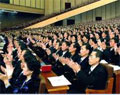
Last September’s 3rd Workers’ Party Delegates’ Conference was a celebratory event to announce North Korea’s new political lineup to the domestic and international audience, according to Park Hyung Jung of Korea Institute for National Unification (KINU).
Park, in the latest of an online KINU series, said, “The existing balance of power was completely changed by various measures executed in February, 2009, after Kim Jong Il had a stroke in August, 2008,” adding, “The rising powers established this as fact through the third Party Delegates’ Conference in September, 2010.”
Park explained, “The ousted governing alliance was the ‘military faction’ that had lead North Korea under the Military-first political line since 1995. This force gradually started weakening from 2005, and its major figures were sent from the political front lines in June 2010.”
According to Park, although Oh Keuk Ryul and Kim Young Chun, both among the highest of this ‘military faction’ were promoted to Vice Chairman of the National Defense Committee and Minister of the People’s Armed Forces respectively in February, 2009, this was actually a way of honorably removing them from seats of real power.
In his piece, Park also cites the following as representing the end of the original Military-first era; Kim Il Cheol, former Minister of the People’s Armed Forces, suffered the indignity of being demoted to first vice minister; the death of former First Vice Director of the Guidance Department Ri Yong Cheol; the dismissal of Kim Il Cheol from the National Defense Commission, the suspicious death in a car accident of former First Vice Director of the Guidance Department Lee Jeh Gang, and the death of Cho Myeong Rok, former Director of Chosun People’s Army General Political Department and First-Vice Chairman of National Defense Commission.
Park analyzed, “When Jang Sung Taek, one of the core members of the rising powers, got appointed to Vice Chairman of the National Defense Commission in June, 2010, the weeding out of the old force was complete.”
He then added, “The Party Delegates’ Conference was planned by the rising powers as a ceremonial event and a rally to strengthen unity and announce the formal launching of this new power coalition, organizing and expanding their force.”
Park explained the organization and stance of the new power elite as follows, “Kim Jong Il, Kim Jong Eun, Jang Sung Taek and other members and a new military grouping are the four parts of the main axis. Certain duties and different interests exist on each axis, while the main policy direction is ‘possession of nuclear weapons + open up to earn foreign currency + anti-reform’.”
However, he also pointed out that the new power elite is weak in the economic sector, saying, “They have achieved certain successes in businesses to earn foreign currencies such as mineral exports, but there are no significant outcomes from other businesses yet.”
In addition, he argued, “Their biggest problem is the ‘anti-reform’ policy,” adding in particular, “Kim Jong Eun, who was responsible for strengthening internal controls both before and after September’s Party Delegates’ Conference.”
This, in Park’s opinion, shows that internal controls are not as effective as the regime would like. By strengthening internal controls, he pointed out, Kim Jong Eun is threatening to harm his own reputation, an issue he cannot afford to take lightly.







