

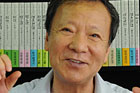
[imText1]“Fire and Ice: 17 Days in the Bitter Cold of Lake Jangjin” is out now, published by a South Korean publishing company, Dongsuh Books. The book, written by the president of the publisher, Koh Jung Il, is based on “Frozen Lake Jangjin”, which was released three years ago.
“Fire and Ice” is a piece of historical fiction which depicts the Battle of Lake Jangjin, a Korean War battle in which the First Division of the U.S. Marines were evacuated from Heungnam in the midst of a vicious battle with hundreds of thousands of Chinese soldiers in freezing weather on the east coast of North Korea.
The Daily NK met with the author of the book to ask why he wrote the book, most of which is based on established testimony, and talk about his life.
– Why did you re-write Fire and Ice, based on the book you wrote in 2007? What’s the difference between them?
I wrote the first book, “Frozen Lake Jangjin,” based on materials provided by Lee Beon Shin, who worked as an interpreter for U.S. Forces during the War. He had his own testimony, war records of U.S. Forces, recorded interviews with U.S. soldiers and a huge amount of other materials.
However, after publishing that book I obtained other materials from the U.S., China, Russia and North Korea. There are many memoirs written by U.S. soldiers, in which there are many stories of soldiers who died without knowing why they had to fight in such a strange country. And through the memoirs of a Chinese Vice-commander, I was able to see the Battle from the Chinese point of view.
What I was thinking when I wrote it again was not about emphasizing anti-communism, but about seeing the two conflicting sides fairly, human beings and war. I did my best to show how horrible war is.
I hope that our youth will discover that our country was founded on the sacrifice of the Cold War between the Soviet Union and the U.S.
– Can you introduce the Battle of Lake Jangjin?
After the success of the Incheon Landing, the First Division of the U.S. Marines and ROK Army retook Pyongyang and went north towards the Tumen River. But they encountered the Chinese army on the Kaema Plateau below Mt. Baekdu. Thereafter, the Battle of Lake Jangjin began, from October 26, 1950 for around 17 days.
Peng Dehuai, the commander-in-chief, had brought around three million People’s Volunteer Army soldiers from China to the Korean Peninsula.
Around 250,000 soldiers from the Chinese 9th Division were in charge of defeating the 25,000-strong U.S. Marines First Division and retaking Heungnam and Wonsan. They marched 240 km in 12 days through a mountainous region and enclosed the U.S. soldiers. The commander told his soldiers that the U.S. soldiers were a snake sneaking into their home, and ordered them to cut it off and kill it.
The U.S. Marines decided to withdraw from Heungnam, which lies in South Hamkyung Province, and tried to evacuate from the besieged Lake Jangjin area. It took 17 days, that terrible battle in Jangjin, South Hamkyung Province. At that time, the most horrible enemy for the U.S. soldiers was the cold weather; the next one was the Chinese forces. -40˚C temperatures gave them extreme pain. Even their morphine was frozen, and there were countless soldiers who lost their frozen legs using only a saw.
The Chinese soldiers who endlessly flooded towards them were another source of shock.
[imText2]– What meaning does the Korean War have in your life?
Some say that sometimes war is inevitable for the development of a country’s history. I never thought like that. Nobody knows how horrible the situations a soldier, a woman or a kid has to go through are unless they experience the same. I lost my mother and brother as they were sleeping beside me during the War. A column fell on my mother, and my brother’s guts spilled out due to bomb shrapnel. Meanwhile, I emerged from that chaos not as a person, but as a blood clot.
After that, I starved for several days, and nine days of starvation numbed me. I survived by begging for food trash left over by American soldiers. I dug trenches in places U.S. soldiers had left in order to find frozen ham and scraps of bread. I was covered with D.D.T. to get rid of the lice all over my body.
– I feel very sorry about your family story. It must be a great pain for you.
That bloody scene comes to mind every day, even now 60 years have passed by. The memory, which was carved on my brain when I was ten years old, will not leave. I suffer from the aftermath of war. I have been living with a feeling of guilt over the death of my mother and brother. Therefore, I can’t even dream of a luxurious or carefree life.
I cannot lose that anguish; why did I survive when my family died? When my house collapsed, I heard a baby cry, which was my brother. In my daily life, I can still hear that baby cry.
– What kind of country is North Korea to you?
Ho Chi Minh of Vietnam was a communist leader who really loved his people. He was not a man of power. People say he had only two suits. He never built any palaces or ate luxurious food. He left one last wish, saying that communism cannot work, you should cooperate with the U.S. and open and reform the system.
Chinese leaders of the Communist Party lived also lives of integrity. Zhou Enlai and his wife left their assets to the poor.
However, in North Korea, Kim Il Sung and Kim Jong Il pass power to their sons. When Kim Jong Il invited the presidents of South Korean media companies to dinner, he served them approximately $5,580 of wine while the people were dying of starvation. If this regime continues to reign, it will be a series of misfortunes for the North’s people.
– What do you want to say to South Korean society?
Lee Seung Hoon, a teacher of many revolutionary elements during the colonial period and a former editor of Donga Ilbo, sternly scolded his students three times every day, saying “Wake up! Guys!” His lesson was that we needed to rouse ourselves even during that colonial period.
When I read current chaotic stories in the newspapers, I feel the same. I think our leadership should also “wake up.” They should not do what they are doing. They should do their best in their fields and increase their power to assist North Korea.
[imText3]







