

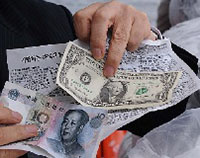
Ahead of the third anniversary of former
leader Kim Jong Il’s death, Pyongyang has been stepping
up its anti-imperialism, anti-U.S. rhetoric, but among students, “ideological deviation” is readily apparent,
with many carrying around U.S. one dollar notes as lucky charms.
“Last month along with the Marshal’s [Kim Jong Eun] visit to the Sinchon Museum, there was ideology
training at factories, companies, and even high schools– all based on
anti-American teachings,” a source based in North
Pyongan Province told the Daily NK on Monday. “But
these students learning anti-imperialism and anti-American teachings keep a one
dollar bill in their uniform pocket for good luck.”
Until a few years ago in the North, a one
dollar or one yuan note was considered rare. However, as USD and RMB become the
dominant tools of trade in North Korea’s markets, even
the most basic of goods–down to a simple block of tofu–are bought using
foreign currency.
Transactions at markets are predominantly
conducted in foreign currency, so much so that if people use North Korean
currency, it is considered antiquated. This prominent use of other currencies
reflects the growing dependence on them within the country and the protracted
devaluation of North Korean money.
Not only is foreign currency commonplace–particularly among students– it has fostered conversation topics unexpected in North Korea. “The students not only carry around the
note, they keep it in their textbooks and talk about the picture of George
Washington on the bill,” the source explained. “They say things like, Washington is not only the capital of the
U.S., it is also the name of the country’s first
president.”
This month has seen North Korea’s state-run media outlets place added emphasis on teachings about
social class, and reacting strongly to a U.N. committee passing of a North
Korean human rights draft resolution, reports are rife with rhetoric such as “Just like fish cannot live out of water, people cannot think about
an independent life with human dignity without anti-imperial, anti-U.S., and
social class related teachings. Victory of the revolution and socialism depend
on how anti-imperial, anti-U.S., social class teachings are carried out.”
Sinchon Museum, recently visited by Kim
Jong Eun, has also closely followed this narrative; photographs of two teenage
students from South Korea, “Hyosun and Miseon,” run over by a U.S. military vehicle in a fatal accident in 2002,
have recently been put on display in its halls. Accompanying lectures inform
students, “Just as the characteristics of a wolf never
change, any fantasy about American imperialism shall lead to death.”
Despite the condemning language against the
U.S., the source reported it has yet to thwart residents and students alike
from demonstrating increased affinity for dollar notes. “For the younger generation that thinks they can go to the university
of their choice with enough USD, they can’t help but
build up a fantasy about the U.S.,” she pointed out.
She added that students see the one dollar
note as bringing greater fortune than the 100 dollar bill because “it is the bill that has the first president of the world’s strongest country, and the number ‘one’ symbolizes a straight path with no roadblock ahead.”
Following the one dollar bill, the five
dollar note comes in second for popularity, noted by the source to be because
it features Lincoln’s likeness. “He is a role model for students–a historic figure who brought about
the liberation of slaves after losing his parents at a young age and no access
to regular education,” the source explained.
These incidents portend the “lucky charm” trend will only become more
pervasive in the nation. “Parents are giving their children one or
five dollar notes as gifts symbolizing their hopes that they will become
important figures who will improve the future,” she
said. “The anti-U.S. teachings may continue, but it
looks like it will be difficult to eradicate fantasies that stem from these
bills.”









