

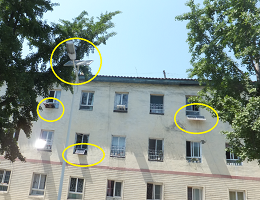
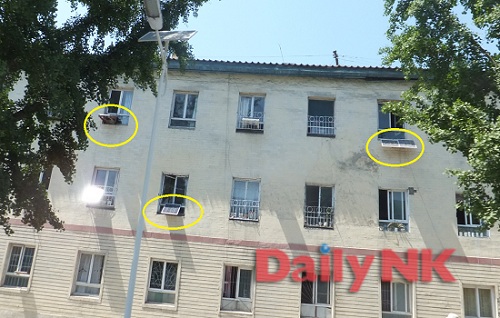
An increasing number of residents in the city of Kaesong are installing solar panels to generate their own electricity. This comes as South Korea withdrew its power supply while pulling out of the inter-Korean industrial park in February, in protest against Pyongyang’s fourth nuclear test and long-range rocket launch.
The power supply from South Korea provided not only for the park itself, but also reportedly benefited many others in Kaesong City.
“At the time of the withdrawals of the South Korean companies, it seemed that having electricity again was nothing more than a dream. But many families in Kaesong now have household lighting, thanks to the installation of solar panels,” a source in Kaesong City reported to Daily NK in a telephone conversation on October 13.
“Many people have installed solar panels over their apartment windows or on the roof of a building. Some are providing electricity for others (for battery charging, etc.) who cannot install the panels themselves, sometimes in return for a small amount of money or food.”
The large majority of North Korean residents no longer depend on the state’s infrastructure, which has been neglected for years. The regime embarked on the construction of hydroelectric plants across the nation to address the power shortage issue, which began rapidly deteriorating in the 1990s. However, most of the electricity produced at these plants is first supplied to buildings and monuments idolizing the Kim family, followed by the second economy sector (military economy), army bases, national agencies, and Pyongyang, ‘the capital of the revolution.’
According to a second source in the area, what small amount of electricity that is sent to the city (by the North) is first given to political departments, leaving the residents with no choice but to generate their own.
“The residents say that ‘all the power plants across the country are useless,’ and ‘solar panels are literally like the Sun in our lives,'” she added. “Some people are even saying [among themselves], ‘Solving problems on our own is the best way; this is the spirit of self-reliance [Juche],’ during social gatherings such as mobilization or political lectures.”
“Now most of the residents are either skeptical about what the regime says, or sarcastic about it. Residents who benefit considerably more from their self-generated power supply rather than state electricity are even complaining about the small quarterly fee (50-100 KPW) they are required to pay for the state-provided electricity,” the source concluded.









