
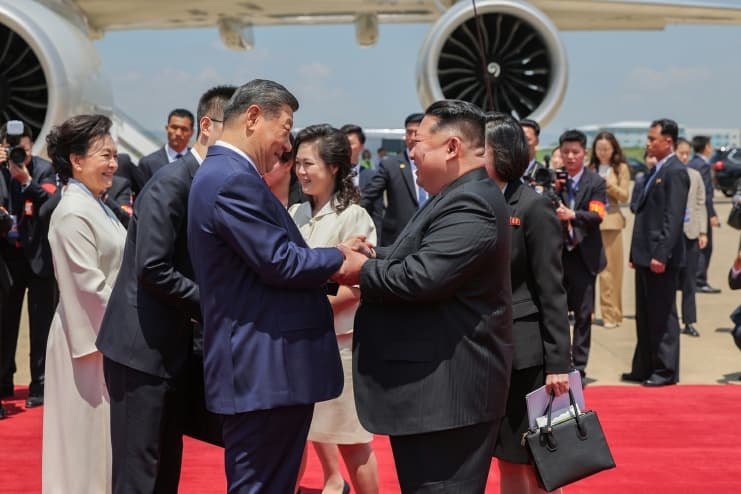
Following Chinese President Xi Jinping’s visit to North Korea on June 8 and June 9, 2026, hopes are reportedly rising among the North Korean people for expanded cooperation between North Korea and China, with many seeing improved relations as a potential turning point for resolving the country’s prolonged economic hardship.
A source in Ryanggang province told Daily NK on Tuesday that since news spread that Xi had visited the country to discuss development between North Korea and China, an atmosphere of anticipation for economic and cultural exchange with China has been forming among Hyesan residents.
According to the source, North Korean state media’s heavy coverage of Xi’s visit has heightened public interest in changes to North Korea-China relations. People are especially focused on the possibility that expanded cooperation could bring an inflow of Chinese capital, on the expectation that if Chinese companies become involved in mineral development, factory operations and tourism, the local economy would be revitalized and living standards would improve.
Notably, hopes are also spreading among the North Korean people for Chinese-style reform and opening.
“There have long been people who view China’s development positively and admire its economic prosperity, since China achieved economic growth by using market mechanisms while maintaining a socialist system, which raised living standards,” the source said. “Since Xi’s visit, people have started saying, ‘We wish our country could be run like China now.'”
Observers point out that chronic economic hardship lies behind this reaction. “What people want isn’t anything grand, just to be able to eat three meals a day without worry,” the source said. “Eating three meals a day doesn’t corrupt anyone’s ideology. If the state simply solved the problem of making a living, loyalty to the country would actually grow.”
Smugglers see opportunity in Xi Jinping’s visit to North Korea
Not everyone views the prospect of Chinese capital flowing in through expanded cooperation positively, however. Smugglers in particular worry that the arrival of Chinese companies could narrow the space for their own activities.
“If Chinese nationals end up running shops or factories directly, there’s a strong chance they would distribute the goods themselves instead of relying on smuggling routes,” the source said. “There’s no shortage of concern that this could mean less work and lower income for smugglers.”
Instead, smugglers are hoping Xi’s visit will serve as an opportunity to revive smuggling activity, which has been largely halted since late last year.
“Smugglers believe that if North Korea-China relations grow even closer, China’s border defense forces, the paramilitary units that patrol the Sino-North Korean border and crack down on illegal trade, may ease their enforcement,” the source said. “They’re saying that if smuggling routes reopen, it would give people working in trade and transport some breathing room to make a living.”
In fact, state-led smuggling, in which authorities themselves organize informal cross-border trade to bring in goods unavailable through official channels, reportedly resumed along the North Korea-China border on June 13, after Xi’s visit, with some electronics already being brought into the country.
Reporting from inside North Korea
Daily NK operates networks of sources inside North Korea who document events in real-time and transmit information through secure channels. Unlike reporting based on state media, satellite imagery, or defector accounts from years past, our journalism comes directly from people currently living under the regime. We verify reports through multiple independent sources and cross-reference details before publication.
Our sources remain anonymous because contact with foreign media is treated as a capital offense in North Korea — discovery means imprisonment or execution. This network-based approach allows Daily NK to report on developments other outlets cannot access: market trends, policy implementation, public sentiment, and daily realities that never appear in official narratives.
Maintaining these secure communication channels and protecting source identities requires specialized protocols and constant vigilance. Daily NK serves as a bridge between North Koreans and the outside world, documenting what’s happening inside one of the world’s most closed societies.