

In the first part of this two-part series, I argued that for the DPRK, nuclear weapons are at best a means of deterrence, but cannot constitute a viable substitute for legitimacy. It should be noted that the challenge that North Korea faces does not emanate from external threats, but from its own internal inconsistencies: the blatant contradiction between the ruling ideology and prevailing reality that has led to the erosion of the Kim regime’s legitimacy and threatens its survival. When it comes to the DPRK’s denuclearization, world leaders must fully grasp this premise.
This brings us to the second and more pertinent question: what would it take for Donald Trump to convince Kim Jong-un to abandon his nuclear arsenal, opening the door to both denuclearization and that much-discussed game of golf? The challenge for Trump is not simply to bargain over weapons, but to make Kim an offer he cannot refuse – an audacious offer that persuades Kim that the DPRK has a better chance of survival without nuclear weapons than with them.
To make such an offer, the United States must secure the endorsement of the other key stakeholder nations – China, Russia, South Korea, and Japan. It is imperative that Trump understands that the United States alone does not have all the means – neither “carrots” nor “sticks” – to offer a viable package deal to Kim. Only a package endorsed by all sides can reverse Kim’s prevailing stance and make a round of golf between Trump and Kim more than just a fantasy.
“Carrots” and “sticks”: a cost-benefit analysis
For both Beijing and Moscow, any deal must guarantee the survival of the Kim regime, and ensure that the DPRK continues to act as a strategic buffer between themselves and South Korea – a US ally. Trump has both “carrots” and “sticks” that he can deploy to secure their support. The most significant “carrot” is the removal of US ground troops from South Korea – contingent upon the complete, verifiable, and irreversible dismantlement of North Korea’s nuclear weapons. This step not only addresses North Korea’s security concerns but also aligns with the long-term interests of China and Russia, easing their concerns over the US military presence on the peninsula. However, Trump also possesses “sticks” he can apply against North Korea, should it reject the deal. If the DPRK refuses denuclearization, or if China and Russia withhold their support, Washington could redeploy tactical nuclear weapons to South Korea, as it has done in the past, or even encourage South Korea and Japan to develop their own nuclear arsenals. Either scenario would render North Korea’s nuclear deterrent obsolete while creating profound security risks for both China and Russia, potentially destabilizing the entire region. In effect, Trump can offer North Korea and its traditional partners a stark choice – a roadmap toward economic development, peace, and regional prosperity, or a drift toward nuclear proliferation, and confrontation in Northeast Asia.

US allies in the region also have a critical role to play. South Korea stands to benefit the most from the DPRK’s denuclearization, therefore it must provide the necessary development funds to support the economic reforms required to achieve economic development within the DPRK. This should be coupled with security guarantees, a peace treaty with South Korea, normalization of relations with the United States, and the removal of American troops from South Korea upon culmination of the deal. Japan can provide diplomatic normalization and economic aid to North Korea, but it also carries unresolved historical grievances that need to be addressed and for which Tokyo would be compelled to compensate.
Ultimately, for the denuclearization of the DPRK to take place, the stakeholder states must come up with a shared policy that is mutually beneficial, rather than a zero-sum game.
Necessary conditions
Any viable denuclearization proposal must acknowledge that North Korea’s nuclear arsenal is not a mere bargaining chip but a core pillar of regime survival, both as a deterrent to real or imagined threats, and as a fulfillment of Kim Il-sung’s mandate. This raises the threshold for any acceptable deal. To bring Kim Jong-un to the table, stakeholder nations must first satisfy a set of necessary conditions – not sufficient for the long-term survival of the DPRK, but essential for Kim to consider negotiations. These include:
- Security guarantees from the United States, South Korea, and Japan to respect North Korea’s sovereignty and security, the normalization of relations through the establishment of embassies, explicit reassurances that its traditional partnerships with China and Russia will remain intact, and signing a peace treaty with South Korea, officially ending the Korean War.
- Lifting all forms of military and economic threats and pressures, including UN-led sanctions, joint US-South Korean military exercises, deployment of advanced weapon systems, and the broader policy of diplomatic isolation.
- Allocating sufficient development funds of at least $30 billion annually – over a period of 10 years – for a total of $300 billion: South Korea, as it stands to benefit the most from denuclearization, would supply the bulk of this funding, supplemented by reparations from Japan.
Meeting these conditions would not automatically ensure the survival of the DPRK. Without nuclear weapons, the survival of the DPRK is contingent upon robust economic development. To achieve this, there are sufficient conditions that need to be met.
Sufficient conditions
The commitments offered by key stakeholders provide only the necessary conditions for denuclearization. They may open the door to negotiations, but they cannot by themselves guarantee the long-term survival of the DPRK. For that, North Korea must meet a distinct set of sufficient conditions:
- Kim must formulate a strategic plan, an economic blueprint that will transform the existing extractive system into an inclusive one. This plan must lay the foundations for economic modernization within 10 years: by achieving robust, economic development, Kim will be able to preserve the integrity of the DPRK, and ensure a peaceful succession process. He must display unwavering commitment to reform and opening in order to achieve an economic miracle, perhaps surpassing even South Korea, Singapore, or China during their peaks.
- For the DPRK’s economy to integrate successfully within the world’s economy, structural market-oriented economic reforms are needed: business entities currently operating without legal sanction in the shadow economy must be legalized, protection of property rights must be guaranteed, and the means of production must cease to be exclusively in the hands of the state. Market reforms are required to replace the dysfunctional economic system with an efficient market-socialist framework, carefully adapted to North Korea’s political and social environment.
- To attract the necessary foreign investment required to achieve economic development, North Korea needs to abandon its current belligerent foreign policy and replace it with an amicable one. Proper legislation to facilitate foreign investments based upon market principles must be introduced. This implies that political reform has to precede economic reform: only Kim holds the power to achieve this.
- Achieving sustained economic growth – an average GDP growth rate of at least 10% annually – will require securing sufficient development funds for an amount of $300 billion from South Korea and other stakeholders. This should be provided as a trade-up for denuclearization. Furthermore, in order to maintain stability, Kim should introduce special economic zones to attract foreign investments and contain the spread of market activities that could undermine his regime.
Unless Kim renounces the Juche ideology no external assistance will save the regime. Juche’s belligerent character makes peaceful coexistence with South Korea impossible. Class struggle remains a core pillar of Juche, and so long as the DPRK holds onto Juche, it will need a perpetual enemy. Even without nuclear weapons, such an ideology guarantees hostility, undermining the very peace a denuclearization deal is meant to secure.
Lessons from past socialist experiences
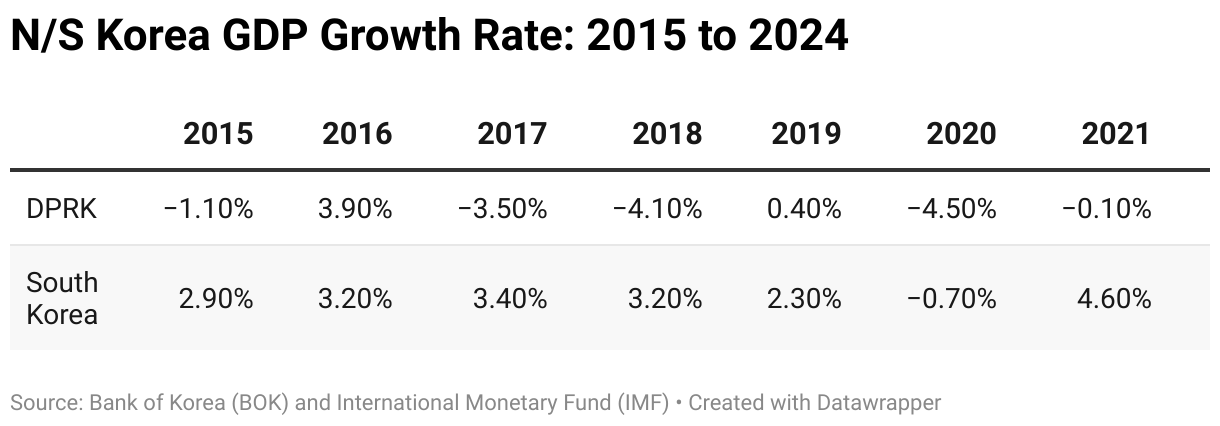
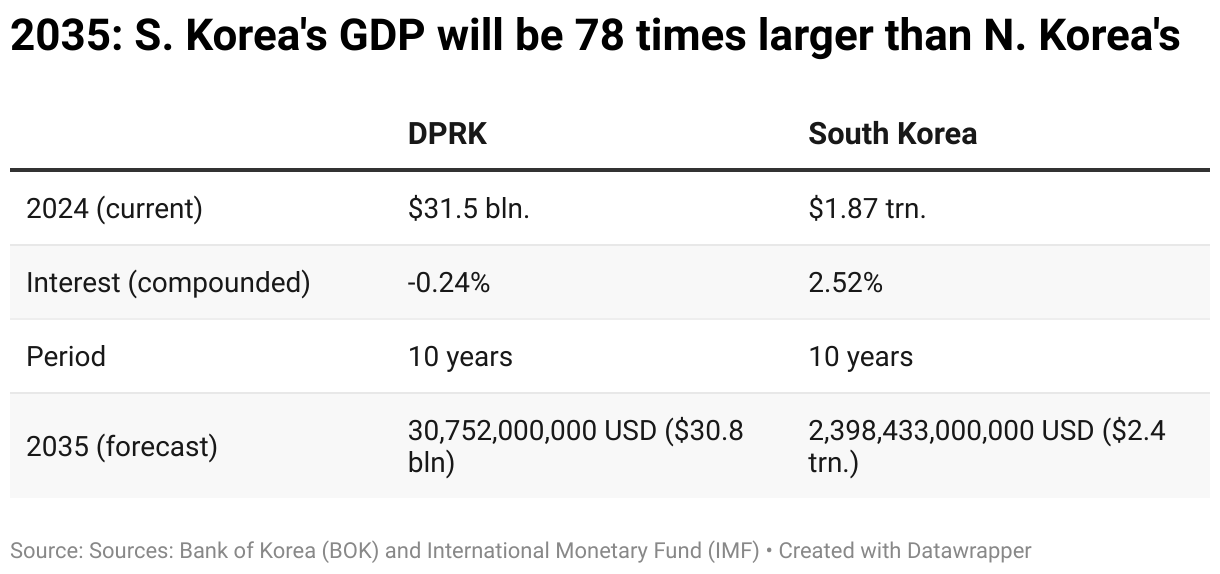
A 2015 Nobel Prize Laureate in Literature, Svetlana Alexievich, quoted a joke in her book, Secondhand Time: “From the very beginning, communism was based on an error. Remember the song, ‘Our train is flying forward, / The next stop is the commune…’…‘Trains don’t fly.” Indeed, historical experience shows that a socialist economic system cannot achieve economic development. North Korea and South Korea are compelling proof of that. The economic gap between North Korea and South Korea is considerable: South Korea’s GDP is 60 times higher than the DPRK’s and, according to our estimations, should the current trend persist, South Korea’s GDP will be more than 78 times higher than the Northern one by 2035. As it was the case for other socialist countries in the past, the crux of the issue is not merely economic, but political – embedded in the ruling ideology on which all socialist systems are founded.
By the late 1970s, China’s leaders, emerging from the upheaval of the Cultural Revolution, recognized that Maoist policies had left the country impoverished and isolated. The challenges faced were daunting – and not just economic, but also ideological. Until that point, the nation’s leaders had been guided by a political mindset based on class struggle. Under Deng Xiaoping, the leadership initiated a bold departure from orthodox Marxism-Leninism. At the Third Plenary Session of the Eleventh Central Committee, in December 1978, the Plenum moved away from class struggle ideology: “From this day forward, we renounce class struggle as a central focus, and instead take up economic development as our central focus.” Central planning gave way to indicative planning, the rationing system was dismantled, and private enterprises – including property rights – were introduced, paving the way for a thriving private sector and foreign investment. While Deng was a pragmatic Just-Do-It leader, under his guidance the party had a major ideological shift. These changes set China on a path of sustained growth and global integration, later mirrored in Vietnam’s Đổi Mới reforms.
In the Soviet Union, it was not until the mid-1980s that Mikhail Gorbachev acknowledged the system’s stagnation and sought to revitalize socialism through glasnost (“openness”) and perestroika (“restructuring”). The reform program included measures such as cost accounting for enterprises, decentralization of economic management, adjustments to price formation, and restructuring foreign trade. However, these reforms remained framed within the ideological boundaries of socialism, and thus lacked the transformative impact of Deng’s approach. In the spring of 1991, I had the chance to meet with Gorbachev. The meeting was organized by Nursultan Nazarbayev, the leader of the soon-to-be-independent Republic of Kazakhstan. I worked with Nazarbayev as his Economic Advisor and as the Vice-Chairman of the Expert Committee, which Nazarbayev himself chaired. Kazakhstan was implementing radical market-oriented economic reform at the time which led to robust economic development, in sharp contrast with the Soviet Union under Gorbachev’s leadership. When I met with Gorbachev, we spent hours together as I tried to argue and persuade him that, in order to save the Soviet Union, a reform of the system was sine qua non. I explained that, without altering the ownership structure and renouncing the ideology of class struggle, no reform would succeed. But Gorbachev was not ready to give up on the ideology he had served all his life and stated that he wished to be remembered as a proud dedicated communist. Eventually, he faced a coup in August 1991 that subsequently triggered the collapse of the Soviet Union.
Conclusion
For Trump, this is more than another deal – it is the chance to write his name into history as the man who turned confrontation into peace. By securing a breakthrough with Pyongyang, Trump could win the Nobel Peace Prize he has long desired. For Kim, the reward would be no less profound – lifting millions of North Koreans out of poverty, laying the foundations for lasting prosperity, and securing his place in history as the leader who secured a bright future for North Korea. This is the only viable plan that can lead to a win-win situation for all stakeholders involved. It is high time for Trump and Kim to put an end to the issue and let golf clubs do the talking instead of missiles.