
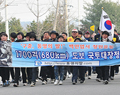
[imText1]As the leader of a group which has now trekked 680km over 23 days as part of the movement to save Shin Suk Ja and her two daughters, Choi Hong Jae believes that the level of interest and affection shown by well-wishers proves that the movement to save Shin Suk Ja has massive potential.
In an interview with The Daily NK following a ceremony to honor the trekkers in Seoul this past Saturday, Choi said, “When we began the trek our objectives were to trigger nationwide interest and make it a stepping stone to the growth of the movement to save Shin Suk Ja and her daughters.”
However, Choi says he was unable to answer honestly when his son, who also took part in the march, asked him whether their actions would really be able to save Shin. “But he got his answer from all the public support we got. Now he is confident they can be saved,” he added.
On top of Choi Jnr’s newfound confidence, Choi Snr says, “I really felt like there was a close bond that developed during the 23 days. All the people who voluntarily took part in the various events, sent postcards (as part of the million signatures campaign) or applauded us along the way were with us in spirit.”
Over the 23 days, the 10-strong members of the group visited more than 30 cities, collecting several hundred signatures every day for the petition to have the three women released. This also provided a timely opportunity for the group to speak to their audience about the pain and suffering of the other 517 South Korean kidnapping victims in North Korea.
Trekking an average of 30km every day took its physical and mental toll on the group. Although the mind was willing, they required physiotherapy and painkillers to get through. The daily slog had some members limping by the end, although none of them gave up. All the group members agree that it was the interest and affection shown by supportive local residents every time they entered a new town that allowed them to complete their mission.
“People seemed very happy to see us every time we reached a new city, and there were some people who drove past us and came all the way back just to give us some health tonic. The spirit of these people, as determined as we are to save the three women and share their pain, was the greatest source of strength for our exhausted bodies,” he comments.
“In every area we visited there were people who gave us new socks and stuff to drink, and there were even some anonymous people who put money to support the cause in the post box along with their petition postcards. One woman in Tongyeong gave us an envelope filled with money, on which she had only written ‘Citizen of Tongyeong’, and I was so grateful that we wanted to ask her name, but she wouldn’t tell us. I remember her shyness vividly. It’s so vivid I can draw a picture of it in my mind,” Choi said.
The group members were accompanied at various stages along the way by younger participants, who the older members say were a source of vigor and strength. Choi’s son wasn’t the only other member of the family present; his daughter went along too, as well as the two children of another group member. The march was so hard that even the youngest of the adult participants required treatment, but it was the children who showed no sign of any discomfort, walking energetically all the way to the end.
According to Choi, “The happiest time of the whole march was when we met the children at Miryang, but actually it was the most physically testing point of the whole experience too. We couldn’t even walk normally by that point but we were so happy to have the children around.” Choi recalls.
“The kids gave us so much strength. Especially seeing the youngest walk the 44km snowy mountain pass at Chupungnyeong, I knew I couldn’t say it was hard. My eldest is a bit heavier and found the going tough early on but adapted to it after a while. The kids were so energetic that it wasn’t at all like we were looking after them; it was more like they were giving us the courage to go on,” Choi said.
▲“If they ignore the Daughter of Tongyeong they have no right to be members of parliament”
But things are not going entirely according to plan. According to Choi, while the movement to save Shin Suk Ja is gaining traction both in South Korea and internationally, unfortunately, the only place where it seems to be falling on deaf ears is the most important, the National Assembly.
“Marcus Lening, the German Human Rights Commissioner, asked as what he could do to help. He talked about taking the issue to Pyongyang, but I told him that our politicians are only interested in the general election next year, and that I wanted to ask these people the basic question of why they wanted to become members of parliament in the first place,” Choi said disparagingly.
Choi continued, “The indifference towards the Daughter of Tongyeong in political circles is embarrassing. The international community has shown a lot of interest in the issue: the German parliament did so when Professor Oh Gil Nam went there, and the U.S. Congress invited him to speak as well; it is only our National Assembly that is not doing anything about it.”
“If our politicians are going to pretend that Shin Suk Ja and her two daughters being locked up in a political prison is not their problem, then they are not qualified to be members of parliament,” Choi said. “There is no serious action taking place within any government agencies to address this issue. A government which is responsible for ensuring the freedom and safety of its citizens cannot afford to have no response to the enormous suffering of some of those same citizens.”
Choi plans to use the awareness created by the march to continue the expansion of the movement to save Shin Suk Ja. Over 50 organizations from all sections of society are currently participating, including the Christian Council of Korea, Korea Freedom Federation, Korean Bar Association, Korean Veterans Association and the Federation of Artistic and Cultural Organizations of Korea to name but a few.