
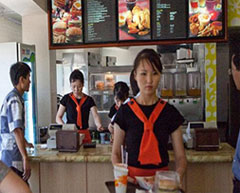
North Korea has been allowing more and more coffee shops and foreign food restaurants to open in Pyongyang for some time now, a trend that doesn’t seem to be letting up despite the state’s crackdowns on all other forms of overseas influence.
The stores actually began to appear following an economic development measure in 2002, but the real impetus for their growth was the loosening of the government’s stance on joint ventures with foreign companies in 2005, providing much needed help and knowhow in establishing and operating businesses. A source in Seoul explained to Daily NK on Tuesday that these Western-style restaurants serving pizza, pasta and wine continue to grow in number.
In June of last year, a fast food joint opened stores in Pyongyang and the Kaeseon Youth Park with the help of a Singaporean company, attracting attention. In May this year, Hana Electronics opened an ultra-high end restaurant in Pyongyang featuring a hair salon, sauna and pool.
Following that, the ‘Vienna Coffee Shop’ opened its doors in the Korean Central History Museum in Kim Il Sung Square. The café was opened by an Austrian company, Helmut Sachers Kafee, which has been investing in North Korea since 2009.
A number of Italian restaurants are also open in Pyongyang, one having opened in December 2008, and another in January 2010, while the ‘Constellation Café’ opened its doors way back in 2005, operated by the Adventist Development and Relief Agency (ADRA).
[imText1]
Foreign and local customers alike are required to pay in Euros. At the Vienna Café, a cup of coffee costs EUR2 (US$2.64), and food anywhere from EUR2 to 8.
The source explained that obviously this is having an effect, saying, “Party officials are able to frequent these places, but actually the majority of customers are foreigners. Even ordinary citizens are allowed in, but naturally the high prices as well as the presence of NSA agents around means people have to be careful about how they approach these places.”
It is also known that Pyongyang department stores are now selling products from luxury brands such as Chanel and Armani. The country’s biggest state-operated department store located in Pyongyang reportedly stocks LCD TVs, computers, USB drives, as well as other items such as furniture and sweets, while a new department store which opened in February last year sells foreign luxury brands such as Chanel and Armani.
The second source continued, “The products on sale at the No. 1 Department Store in Pyongyang were reported with photos in the Rodong Shinmun on July 12th this year following on-the-spot guidance from Kim Jong Il. According to people who have visited North Korea, department stores are also selling other basic items aimed at the upper class, such as German chocolate, mustard sauce and baby diapers.”
North Korea makes no secret of its desire to obtain extra foreign currency. Last year authorities invited over 80 foreign journalists to an event marking the 65th anniversary of the foundation of the Korean Workers’ Party, which mainly consisted of publicity events for the nation’s restaurants and theme parks, while one of the eye-catching plans available on the Koryolink cell phone system is a discounted plan denominated in Euro.
Given these circumstances, it appears likely that for the time being the government will continue to only allow foreign investment in the form of joint ventures to operate inside the country, rather than unleashing the full force of outside capital.