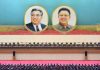

As a North Korean citizen, one would have reflexively conjured up the face of Kim Il Sung yesterday morning. In North Korea, when one learns to walk and starts to speak, one naturally learns the words, “Our Father the Great Leader,” and how to bow before Kim Il Sung’s portrait.
Although it has been less than a year since I arrived in South Korea, I do not know if it is due to the stark change in my surroundings, but my time in North Korea is becoming hazier. Defectors like me may think, “Have I already become a South Korean?”
Despite these changes, I could not help Kim Il Sung’s face from coming to mind the moment I woke yesterday morning, April 15th, Kim Il Sung’s birthday.
Even in my state of semi-consciousness, the words that remind me of Kim Il Sung, like “Great Leader,” come up in my mind. I cannot help but to feel agitated by the fact that I have not been able to forget this relic.
South Koreans who see the festivities in North Korea for Kim Il Sung’s birthday say, “I do not understand the reverence towards him. It is not as if he is alive or a god.” After arriving in South Korea, I found out that many South Koreans feel discomfort while watching on TV the images of North Korean citizens lamenting Kim Il Sung’s death in 1994.
In actuality, North Korean citizens, who cannot rationally evaluate the North Korean regime, do not harbor such hostility towards Kim Il Sung.
The shock of the great famine after Kim Il Sung’s death was so critical that people have not had the chance to objectively assess him. This may be a simplistic expression, but most North Korean people believe that “Things were not this bad when the Great Leader was alive.”
I had a phone conversation with an acquaintance from North Korea yesterday evening. In Gapsan in Yangkang Province, a kilogram of rice apparently costs around 2,100 North Korean won. A kilogram of pork costs 4,500 won and a kilogram of corn 800 won.
The acquaintance grumbled, “The state did not provide any rations even on a national holiday, and food prices have been rising during this spring season.”
He said, “On April 15th, which is proclaimed the supreme holiday in North Korea, every citizen, whether an official, civilian, rich or poor, discusses ‘politics.’ People say that before the March of Tribulation (in the late-1990s), the smell of rice cakes and food would permeate from every household on April 15th, but nowadays, not a single household will cook even a serving of meat.”
“Also, wealthy households, out of fear of getting caught during National Security Agency (NSA) inspections, do not go out of their way to celebrate the holiday. No wonder that people yearn for the era when the Great Leader was still alive.”
Defector Kim, who entered South Korea in February 2009 and lives in the same neighborhood as me, also reflected, “In retrospect, we did not live very well during Kim Il Sung’s rule, but at least we did not have to worry about food. Normal rations were provided and North Korean-produced goods could be found in the shops.”
He recalled, “One cannot compare North Korea with wealthier countries such as South Korea, but based on living standards at the time, things were not so bad. People could eat three meals a day and receive necessities such as shoes and clothes from the nation.”
“While Kim Jong Il has been insisting on his self-righteousness in external relations and his military-first political theory, Kim Il Sung had true political depth and long-standing relations with China and Russia; he could enjoy relatively strong ties with outside powers.”
Until the 1980s, North Korean people did not even dream that they would be a nation dependent on outside support for survival. Although they were not able to save for the future or develop their capabilities to the fullest, they were relatively content.
After Kim Il Sung’s death, Kim Jong Il set up an “Immortality Tower” in every village. On every tower, the following inscriptions could be found.
“The Great Leader, Comrade Kim Il Sung exists with us forever.”
The irony is that Kim Jong Il has been hiding behind his father’s political propaganda and has normalized his tyranny, the logic being that he is the son of the eternal General so the citizens have to offer their devotion and duty in entirety. However, this will not last long.
People evaluate ironically that Kim Il Sung’s period was not bad, but the reality of Kim Il Sung as a tyrant may be revealed soon. With the third-generation of succession about to unfold, the final days of Kim Jong Il’s disobedience, which has brought disgrace on his deceased father, are not too far off.