South Korean agencies such as the Korea Meteorological Administration, Korea Institute of Nuclear Safety and Korea Institute of Geosciences and Mineral Resources are stepping up monitoring activities in light of the danger that North Korea could test a nuclear device in the coming days, and are increasing mutual cooperation with the ROK military.
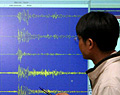
Korea Meteorological Administration has established a two-person, 24-hour surveillance team to monitor for signs of man-made earthquakes emanating from the North. At the same time, Korea Institute of Geosciences and Mineral Resources is performing 24-hour monitoring of seismic activity.
Seismic waves travel extremely rapidly through the earth’s crust at speeds of 6.5km/sec, meaning that signs of a test should be noted within a few minutes in South Korea, Russia and China.
An official with the Korea Meteorological Administration told Daily NK earlier today, “We analyze whether an earthquake’s waveforms are artificial or not, whether it was caused by an explosion or not, and collect information on the place or origin. We then share that with the administration.”
Professor Hong Tae Kyung of Yonsei University explained more, saying, “Natural seismic waves occur when the earth’s crust moves, but there is no such occurrence with a nuclear experiment. The two types can be distinguished that way.”
“North Korea’s nuclear test site is only 400km away from South Korea’s monitoring station, but it will only take about a minute for us to detect the waves and a few hours to determine whether it was a nuclear test or not,” he added.
Elsewhere, Korea Institute of Nuclear Safety is also operating two xenon ‘saunas’. The ‘saunas,’ one in the northern sector of the East Sea and another in the West Sea, are designed to detect xenon, a gas that is released in huge quantities at the time of a nuclear detonation.