
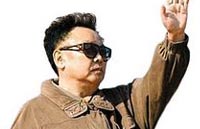
[imText1]As the year 2007 has come, South Korean media highlight what kind of future Kim Jong Il regime would face in the upcoming year.
A majority of the projections depict gloomy future of North Korea’s dictatorship, such as what would come next after Kim Jong Il regime’s collapse or possibility of military coup. Some of them might be correct, while others are far from reality. The point is bombardment of media focus on Kim Jong Il regime’s insecurity, which is the first since the mid-90s famine. During the time of March of Tribulation, many scholars predicted the regime’s demise due to mass starvation and Kim Il sung’s death.
The calculation turned out to be wrong and, as a result, many still believe in North Korea’s incredible ability of sustaining tremendous amount of hardship that is usually unbearable to other dictatorships and coercive regimes.
North Korea-collapse prediction in the 90s was actually an erroneous one. Outside watchers emphasized role and impact of Kim Il sung, the charismatic ‘eternal president’ of North Korea who ruled the country for five decades. North Korean regime at the time of Kim Il sung’s death, however, was already in complete control of his son and heir to the throne, Kim Jong Il. KJI had been named as his father’s successor for 20 years and been Commander-in-Chief of the Korean People’s Army since 1991. Kim Il sung’s death in 1994 meant no crisis in the regime.
In addition to the characteristics of Kim Jong Il’s power structure, outer environment of North Korea in mid-90s helped Kim’s survival. In 1994, the U.S. and North Korea signed the Agreed Framework in Geneva as an act of compromise and the Clinton administration had kept pacifist approach to Pyongyang since then. Moreover, China at that time did not want a nightmare of its neighbor’s sudden collapse to be realized.
Ten years have passed since the worst period of famine, and the situation is totally changed.
Most of all, Kim regime is confronted with the international society as a whole. After a series of militarist activities of missile launch and nuclear test, UN and the US are applying harder-than-ever sanctions against North Korea.
China, NK’s most significant and powerful ally, is also differed. Beijing’s attitude toward Pyongyang is no more friendly, especially since the nuke detonation. Of course China has not turned down its long-time communist comrade yet; however, Chinese leadership’s patience would draw to an end if Kim Jong Il does not stop his extremist behavior.
Last but not least, North Korean population is transformed, too. Since the mass defection in mid-90s, outside information has been constantly flowing into North Korea and market economy is rampant. In North Korea’s totalitarian society, spread of private market is quite, if not most, threatening to regime.
Also, most of the North Korean people know well about South Korea and China’s economic growth, and Kim Jong Il’s reputation plummeted.
Considering current in-and-outside conditions surrounding North Korea, this time it is sure that Kim Jong Il regime’s demise is apparent, although when and how the totalitarian state would collapse is still in question.
For ten years, South Korea’s Sunshine policy aimed at peaceful coexistence of North and South Korea while leading the North to open and reform.
The policy failed to neutralize Kim regime’s militarism and rather resulted in North Korea’s nuclear armament, whether directly or indirectly.