
In light of growing discontent in the Bush administration and South Korean political circles over the delay in North Korea’s implementation of the “October 3 Agreement”–the Six Party Talks’ agreement on second-phase actions for the implementation of the September 19 Joint Statement– North Korea’s propagandistic media issued a warning to the outside world.
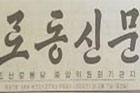
The Rodong Shinmun, the Chosun (North Korea) Worker’s Party’s mouthpiece, insisted on the 8th, “If the U.S. hard-line conservatives come forward with an entirely hard-line policy by opposing dialogue and negotiations, everything that has been achieved through dialogue thus far will vanish in an instant.”
Rodung Shinmun maintained, through an editorial entitled “An Entirely Hard-line Policy will do More Harm Than Good,” that ” U.S. hard-line conservatives perceive that our nation [North Korea] will not abandon our nuclear weapons until the end of the Bush administration, so they have been using obscenities and calling for the need to complete negotiations related to the nuclear issue.”
It added, “They are going around saying that our human rights should also be selected as a topic for negotiation, so that the room to pressure us can be widened.”
Recently, six U.S. Republican senators, including Chuck Grassley and Sam Brownback, sent a letter to President Bush urging that North Korea not be removed from the list of terrorism-sponsoring countries before an accurate and complete nuclear declaration is completed.
This comes on the heels of Jay Lefkowitz’s, Special Envoy for Human Rights in North Korea, recent comment last month that, “It is increasingly clear that North Korea will remain in its present nuclear status when the administration leaves office in one year.” (AFP, January 17, 2008)
Additionally, he insisted that the U.S. needs to rethink its approach to North Korea to one that links concerns about security with North Korea’s poor human rights record. (CNN, January 18, 2008)
Rodung Shinmun warned, “As the two nuclear crises on the Chosun (Korea) Peninsula showed us in the past, the pursuit of a strength-based policy without dialogue will not resolve the issue, but will only cause an explosive crisis. If the U.S. pro-war faction continues to come forward in an aggressive manner, we cannot help choosing a measure commensurate with their attitude.
“If the U.S. hard-line conservatives continue to oppose the resolution of the issue through dialogue and negotiations and try to lead the Chosun Peninsula’s situation and U.S.-Chosun relations into a worse state, then the achievements thus far will evaporate into nothing and that responsibility will entirely be borne by the U.S.”
The reason for North Korea’s harsh words can be attributed to the deterioration in international sentiment towards the North and the long stalemate of the Six Party Talks.
In the midst of the current situation, in which the deadline for the most recent step in the “October 3 Agreement” is overdue by 40 days, North Korea has been laying the responsibility for the delays on other participant nations in the Six-Party Talks for not sticking to the “action for action” principle. However, it seems that North Korea figured out that these assertions were not so persuasive.
In particular, after confirming the U.S.’ unyielding position on the declaration of the North’s nuclear programs and a suspicion over the development of the Uranium Enriched Program (UEP), Pyongyang may be trying to be on the advance lookout for a shift in the Bush Administration’s North Korean policy to a harder line.
“The pursuit of a hostile policy towards the North by U.S. hard-line conservatives only amounts to a catalyst for North Korea to grow its army’s and people’s anti-U.S. mentality by 100 times,” said an analyst. That is, if the U.S. carelessly takes a hard-line stance towards the North, North Korea will respond with “brinkmanship.”
The editorial also criticized recent moves by the US and its allies to establish a missile defense system. “There has been insistence that the U.S., Japan, and Australia should cooperate on the establishment of a missile defense (MD) system. That is an anti-pacifist act that will revert the situation to the pre-Six Party Talks by destroying the process of denuclearization on the Chosun Peninsula and by increasing the threat-level through coercive policy.”