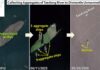

Daily NK has obtained critical intelligence about North Korea’s uranium processing facility in Pyongsan, located in North Hwanghae province.
According to sources, North Korea is well aware that the international community monitors its major facilities through satellite imagery. This past February, the regime conducted a special briefing warning that “our enemies’ eyes are in the sky.”
Following that briefing, state security agents intensified their surveillance of the population to strengthen security and protect sensitive information.
To evade international satellite monitoring, North Korea has shifted factory operations and waste disposal to nighttime hours, when contaminated water and other waste materials are released under cover of darkness.

For this investigation, I conducted a detailed analysis of thermal infrared and nighttime light imagery of the Pyongsan facility, tracking nighttime activities over an extended period. Our analysis revealed that thermal infrared imagery showed significantly higher activity levels this year compared to last year. Meanwhile, nighttime light imagery confirmed that the factory’s after-dark operations have increased substantially during this timeframe.
I examined the current layout of the processing and production facilities at the Pyongsan Uranium Concentration Plant. The facility designations are based on analysis from 38 North and Beyond Parallel, respected U.S.-based organizations specializing in North Korean affairs.
The complex process of converting uranium ore involves multiple stages—selection, crushing, leaching, sorting, and settling—before the concentrate can be produced. The uranium waste remaining after processing is transported via pipeline from the wastewater treatment facility to a settling basin on the opposite side of the river.
Transportation and operations
Satellite images reveal 12 freight cars positioned on the facility’s left side. These cars, estimated at 10 meters in length, are likely either waiting to transport uranium concentrate produced at Pyongsan or have delivered raw materials and chemicals to the facility. The cars appear ready for departure once connected to a locomotive.
According to an internal source, uranium concentrate from the Pyongsan plant is shipped to uranium processing and enrichment facilities in North Pyongan province, Jagang province, and the Nampo area. North Korea operates a specialized train for uranium concentrate transport that runs on military rail lines approximately twice monthly.

My thermal infrared analysis shows the Pyongsan plant was operating at full capacity in June 2025, generating unusually high heat levels (indicated by red to dark red signatures). The same facilities operated at much lower intensity (light purple signatures) in June 2024.
The Pyongsan Uranium Concentrate Plant appears to have significantly increased its operations since North Korean leader Kim Jong Un ordered an expanded nuclear arsenal in September 2024.

Images from the Visible Infrared Imaging Radiometer Suite (VIIRS) on U.S. satellites show increased nighttime lighting at the Pyongsan plant this year compared to previous years. Key images from each of the past four months demonstrate this pattern. The factory complex remains illuminated at 1 a.m., suggesting workers are actively producing uranium concentrate during late-night hours.
Kim Jong Un’s orders
Last September, Kim Jong Un made an unannounced visit to a previously undisclosed facility for producing highly enriched uranium (HEU). Photographs released by North Korean state media showed portions of the facility, raising international concerns and attracting significant attention.
While there was initial debate about whether the facility was located at Yongbyon or Kangson, Rafael Grossi, director general of the International Atomic Energy Agency (IAEA), believes the site is at Kangson.
During his visit, Kim ordered staff to focus on producing weapons-grade fissile material. These satellite images indicate that the Pyongsan facility also responded to Kim’s directive by increasing uranium concentrate production.
Environmental impact
According to a source inside North Korea, livestock near the Pyongsan plant died in large numbers in March, and area residents have reported water quality problems and strange odors from local wells.
State security agents have moved quickly to suppress these reports and pressure locals to remain silent. This suggests North Korean authorities recognize that environmental contamination around the Pyongsan Uranium Concentrate Plant poses health risks to nearby communities.