
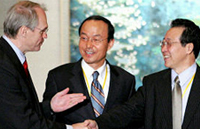
[imText1]Prior to the reconvening of the six party talks, Christopher Hill, head of the U.S. delegation to the six party talks and Assistant Secretary of State for East Asian and Pacific Affairs and Kim Kye Gwan, Vice Minister of the Ministry of Foreign Affairs in North Korea met in Beijing on the 28th for bilateral talks. It had been predicted that these talks will be the pinnacle for future negotiations.
This meeting drew particular attention as it would ascertain whether or not North Korea had any intentions in surrendering its nukes at the reconvening six party talks. In addition, it was anticipated that issues concerning the freezing of North Korean accounts and Banco Delta Bank, measures North Korea would take in abolishing its nukes and its correspondence with related countries, and measures to lead a profitable six party talks would also be discussed.
◆ Issue of financial sanctions = It seems that North Korea is rejoining the six party talks under prior settlements and will push for the removal of financial sanctions. In response the U.S. discussed the issue of financial sanctions with a working group, while the North agreed to rejoin the talks based on the assumption that the issue of financial sanctions will be discussed and resolved with its removal. Hence, it is speculated that the negotiations may be in turmoil.
Last 20~21st, Assistant Secretary Hill visited Beijing with a 5 item plan for the reconvening of the six party talks which were proposed by the working group based on negotiations and discussions on the issue of financial sanctions in relation to BDA, denuclearization, normalization of the U.S.-North Korea relationship, energy supply to North Korea and peace issues in North East Asia.
Also, in contrast to claims made by North Korea, the U.S. explained that the working group was not established to remove the sanctions. Simply put, it was only said that as North Korea is placing heavy interest on this issue and the possibility that negotiations may be made in relieving some of the sanctions could not be excluded.
◆ Nuke eradication program = According to a Japanese newspaper, Yomiuri Shimbun, if the six party talks resume, the U.S. and Japan would be obliged to promises made in the ‘six party talks mutual agreement’ last September to eradicate nukes which included 3 items requested by North Korea.
The 3 items included an apology for the nuclear experiment in October and the end to unlimited re-tests. ▲ An agreement to report all facilities related to the International Atomic Energy Agency for inspection and ▲ To complete all action within the time frame set by the six party talks mutual agreement.
Concurrently, the Japanese government is considering adopting a ‘Roadmap to surrender nukes’ while investigating whether or not it will agree to North Korea’s mutual agreement.
However, there is a high possibility that North Korea will join the talks as a nuclear possessing state relying on its nuclear strength for a 3-party talks and like Vice-Minister Kim said “Through the nuclear experiments we have shown our response to the U.S. and our preference for defense, so we can take a bold stance in the talks.”
Last 31st, Assistant Secretary Hill said “Though we revealed honestly, that we could not accept North Korea as a nuclear possessing state, North Korea aspires for negotiations on nuclear weapon control after we accept North Korea as a nuclear possessing nation” and criticized “North Korea has created a difficult situation with the nuclear experiment and as a result honestly needs to establish another condition.”
◆ Issue of energy supply = On the 28th Assistant Secretary Hill told Vice-Minister Kim that energy will be supplied to the North, on the basis that North Korea plans to abolish its nukes at the next six party talks, promises to freeze its 5MW atom in Yongbyon and honestly reports its current stance on nuclear facilities including its weapons, equipment and materials.
In response, Vice-Minister Kim claimed that just as much as North Korea demonstrated that it is a nuclear possessing state by the nuke experiments, the North Korea-U.S. relationship will not be normalized nor will the nukes be abolished until the U.S. sets precedence by promising oil and energy supply.
In short, though the issue of energy supply and North Korea abolishing its nukes is yet subject to discussion, it appears that the U.S. is investigating the issue of providing oil and negotiating at a level in which North Korea desires.
Though the freezing of nuclear facilities may be the first measure in abolishing North Korea nukes, at the present stage, the U.S. is taking a basic stance arguing that it cannot return to the 500,000tons of oil that was agreed by North Korea and the U.S. and supplied annually since the Geneva Agreement in ’94.