
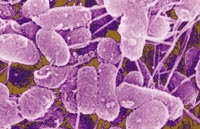
[imText1]Lee Jae Jong, the Minister of Unification, announced on the 11th that there are no plans to send Scarlet Fever medication to the North. After first appearing in Yangkang Province in October last year, Scarlet Fever is spreading widely throughout the interior of country.
Minister Lee, stated during the regular briefing at the Combined Government Complex located on Saejong Road that “I know that the infectious disease known as Scarlet Fever is not a dangerous disease that can cause death,” and announced that “we judge that the North can resolve this by themselves, and do not plan to provide special support.”
As this paper first reported in October of last year, the spread of Scarlet Fever generally can be halted by Penicillin or other antibiotics, followed by quarantining the patient for 24 hours. We also reported that domestically, between 60 and 100 infected patients are seen each year.
In our previous article, we quoted a source from the Center for Disease Control as saying that “We have information that Scarlet Fever is spreading rapidly in the North, and are studying preventive countermeasures just in case. Domestically, it is known only as a Category Three level infectious disease, however, with the medical shortages in the North, is appears that there have been fatalities.”
Additionally, we reported that according to North Korean internal sources, as of last December some trains had been halted and schools closed as the North struggled to contain the spread of the disease. Scarlet Fever has begun to spread fully throughout Yanggang Province’s Haesan, Bochonbo, and Baekam in the North’s border region, and is steadily spreading through the interior.
The comment that the North does not need medical aid to fight an epidemic is an absurd response coming from the same Minister who posed the concept that Humanitarian Aid should continue in spite of the North’s recent nuclear test.
Humanitarian Aid groups and North Korean Human Rights groups are of the opinion that the issue of the epidemic should be handled in a completely transparent manner. It has been suggested that the recent announcement by the Ministry of Unification of their decision not to provide medical aid is in response to a sensitivity to the negative view of support to the North currently being expressed by press and politicians. .
Additionally, Minister Lee insisted that the relationship between the North and the South has improved from one of confrontation and tension to a relationship of conciliation and cooperation. In order to advance the development of this conciliation and cooperation, “Peace Education” needs to be introduced into schools and social reunification education.
Minister Lee said “In order to do this, we must establish a consultative organization between the Ministry of Unification, the Ministry of Education, Peace Education Execution groups, and related agencies, and develop concrete and realistic measures. However, he did not reveal any specific details on what exactly “Peace Education” consists of in the plan.
On the one hand, in a situation where national security has been shaken by the North’s missile and nuclear tests, voices are rising as worries increase over the Kim Dae Jung Roh Mu Hyon government’s policy of unilaterally glorifying cooperation with the North.
Minister Lee, in today’s announcement, quoted Laotzu’s that “A whirlwind does not blow all morning, nor does a rain shower last all day.”
Because of the sanctions resulting from North Korea’s nuclear and missile tests, the current North South relationship is experiencing some difficulties, but the issues will sooner or later be resolved, and there is hope that the suspended North South talks will restart.