

Satellite imagery has revealed that North Korea built a private rail station for Kim Jong Un at the center of the newly inaugurated Sinuiju Combined Greenhouse Farm on Wihwa Island, near the Chinese border in North Pyongan province, Daily NK has confirmed. The station, which bears what appears to be a State Affairs Commission emblem, signals that the landmark agricultural project doubles as a dedicated security and leadership mobility hub.
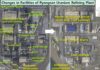
A new branch line now splits off from the Dokhyon Line, the regional rail route connecting Jongmunri station to Uiju station, and extends onto Wihwa Island, a Yalu River islet where severe flooding struck in the summer of 2024. The branch terminates at a newly constructed station, identified as Wihwa Island Station, situated at the heart of the greenhouse complex. The station measures roughly 300 meters by 40 meters and is believed to function as a so-called “No. 1 station,” a designation in North Korea for dedicated rail facilities reserved for the supreme leader’s exclusive use.
Imagery from Planet Labs and footage broadcast by Korean Central Television both support this assessment. In KCTV footage, a faint light-yellow emblem is visible on the station building’s roof parapet. A Daily NK source familiar with the matter identified the symbol as the badge of the State Affairs Commission, the country’s highest state policy organ, which Kim chairs. The presence of that emblem on a station at a regional agricultural complex strongly suggests the facility was never intended for standard passenger or freight traffic.
Security implications of a dedicated leadership station

The Dokhyon Line is itself a branch of the Pyongui Line, the main artery linking Pyongyang to Sinuiju. That a further dedicated spur was built off a secondary line specifically to serve Wihwa Island points to a broader pattern: North Korea routinely pairs high-profile national projects with the parallel construction of secure leadership transit infrastructure. Kim attended the groundbreaking ceremony in February 2025 and made multiple field guidance visits during construction before presiding over the inauguration in February 2026. Each of those visits likely required pre-cleared, segregated rail access.
Analysts note that areas where dedicated leadership rail stations are installed tend to be designated as permanent restricted zones. In such areas, North Korea typically enforces heightened surveillance, limits civilian movement, relocates some existing residents, and expands the presence of security and state protection agency personnel. Taken together, the Wihwa Island station points to the transformation of the site from an agricultural development zone into a structurally controlled strategic space.
Wihwa Island and North Korea’s regional development drive
North Korea built the large greenhouse farm across vast areas of Wihwa Island after the site suffered severe flood damage in the summer of 2024. The complex covers 450 hectares, which would make it the largest greenhouse complex the country has announced. Hortidaily At roughly 1.5 times the area of Yeouido in Seoul, the development was framed by state media as the centerpiece of Kim’s regional development policy ahead of the Ninth Congress of the Workers’ Party of Korea (WPK).
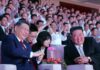
The complex includes more than a thousand modern greenhouses of varying types, a vegetable science research center, and residential and cultural facilities. Kim reviewed over 170 layout designs and more than 3,850 technical drawings during the construction process, according to the Korean Central News Agency (KCNA). Kim called the project a “wonderful achievement” at the inauguration ceremony and described the farm as a “base” for new life for people in the Sinuiju area.
Key indicators to watch
The actual strategic character of the Wihwa Island complex will come into sharper focus depending on several observable factors going forward. Chief among them is where produce from the farm is distributed: whether it flows to military supply chains and state institutions, to civilian markets, or to designated research or regional distribution networks will clarify the political and economic purpose behind the project.
Equally significant are changes in civilian movement and population controls around Wihwa Island. Large-scale national projects of this type in North Korea have historically been accompanied by demolitions, access restrictions, and expanded security agency operations in surrounding areas. Observers should also watch for additional rail, road, or security infrastructure, any cross-border logistics activity with China, and the frequency of Kim’s continued field guidance visits to the site, all of which could help assess the long-term strategic weight Pyongyang assigns to the location.
Reporting from inside North Korea
Daily NK operates networks of sources inside North Korea who document events in real-time and transmit information through secure channels. Unlike reporting based on state media, satellite imagery, or defector accounts from years past, our journalism comes directly from people currently living under the regime. We verify reports through multiple independent sources and cross-reference details before publication.
Our sources remain anonymous because contact with foreign media is treated as a capital offense in North Korea — discovery means imprisonment or execution. This network-based approach allows Daily NK to report on developments other outlets cannot access: market trends, policy implementation, public sentiment, and daily realities that never appear in official narratives.
Maintaining these secure communication channels and protecting source identities requires specialized protocols and constant vigilance. Daily NK serves as a bridge between North Koreans and the outside world, documenting what’s happening inside one of the world’s most closed societies.