
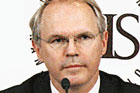
Christopher Hill, the U.S. Assistant Secretary of State for East Asian and Pacific Affairs, siad on the 16th, that the North Korean nuclear negotiations has entered the Third Phase of affairs, “as part of normalization, we will of course be discussing human rights.”
Hill, in an interview with the Council on Foreign Relations, pointed out, “Human rights needs to be understood by the North Koreans as really the price of admission to become a member of the international community.”
Jay Lefkowitz, Special Envoy on Human Rights to North Korea, said on the 17th of last month, “North Korea will maintain in its present nuclear status when the administration leaves office in one year.” (AFP, January 17, 2008) Additionally, he said, all negotiations with North Korea should be connected to human rights, economic aid, and security issues.
He is the envoy for issues related to human rights in North Korea. He is not, however, somebody who speaks authoritatively about the six-party talks.
In response, Sean McCormack, Spokesman of the Department of State had said on LefKowitz’ statement that, “He is the envoy for issues related to human rights in North Korea. He is not, however, somebody who speaks authoritatively about the six-party talks.” And, he quoted what the Secretary of State said on it, “f you listened to what the President of the United States says, the Secretary of State says, and Ambassador Hill said, those are the people who are involved in the policy process who speak authoritatively.”
In contrast to Secretary of State Rice’s refusal of even the possibility of the connection between the Six-Party Talks and North Korean human rights issues, Assistant Secretary of State Hill, who is directly under Rice’s control, revealed a bit more relaxed position. Roughly, his point of view is that treating North Korea’s human rights issue under the framework of the Six-Party Talks is itself significant.
However, since the presupposition of “the Third Phase” has been taken, a skeptical response regarding the effectiveness of such a connection has also been proposed.
Song Dae Sung, the Researcher at the Sejong Institute said in a phone conversation with DailyNK on the 17th, “Two different meaning can be perceived–if North Korea decides to completely abandon its nuclear programs, the remaining agenda can include ‘human rights’ and even if actual abandonment does not appear possible, this issue will be treated.”
However, he pointed out, “Discussing the human rights issue in the 3rd phase of negotiations is equivalent to saying that it cannot be discussed for a while. As long as the 2nd phase of denuclearization–the declaration issue–is in a stalemate and North Korea has not abandoned ‘military-first politics,’ the likelihood of North Korea abandoning its nuclear programs will be small.”
Regarding to the declaration of the nuclear programs, Hill expressed, “The problem is not that they’re not willing to provide a declaration. The problem is they don’t want to give us a complete and correct one. And we don’t want to accept something that’s less than complete, less than correct.”
He urged that “They are prepared to give us a figure for the separated plutonium. From my way of thinking, it is not so important what the figure is. What is important is that we be able to verify it.”
Additionally, he emphasized the importance of accurate reporting apart from the actual amounts of the declaration’s programs. “Now, if it comes in at fifty kilos and the verification process turns out it should be sixty, then we have a gap of ten. That’s a problem. If it comes in at thirty and the verification shows that thirty is correct, then we don’t have a problem.”
Regarding South Korea’s and China’s unconditional aid to the North, he portrayed the high level of dissatisfaction with South Korea’s and China’s economic aid until now, “It’s important that what South Korea and China do directly with North Korea gets somehow coordinated with the Six-Party process.”