
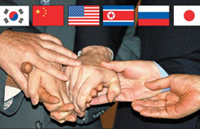
[imText1]On the second day (19th) of the fifth round of six party talks which resumed after a 13 month vicissitude, the wide gap between the U.S. and North Korea could not be tightened as the Banco Delta Bank (BDA) conference was opened at the U.S. embassy in Beijing.
While North Korea deems itself a “nuclear possessing state” and proclaims a reduction of arms talk, U.S. Assistant Secretary of State Christopher Hill hints for less dependence and progress, as the BDA financial talks began in conflict with each other.
The head delegates for the U.S.-North Korea BDA financial talks pending the question of $24mn illegal funds are President Oh Kwang Chul of the Foreign Trade Bank of North Korea and Daniel Glaser, Deputy Assistant Treasury Secretary.
North Korea has rejected bilateral talks with the U.S., though now President Oh as head delegate has aggregate power for the BDA financial talks and is demonstrating an attitude that they will decide future direction in dependence on the outcome of the negotiation.
It has been analyzed that North Korea will try and scrutinize each item of the BDA issues as it is approached as a political issue not a financial one. At the same time, as insinuated by the North Korea’s Vice Foreign Minister Kim Kye Gwan, serious negotiations regarding the nukes will only begin when the financial sanctions have been removed.
While North Korea’s representative, not even a foreign minister but a financial expert argues with Deputy Assistant Treasury Secretary, Daniel Glaser that the BDA accounts were legal, it seems that this strategy is to remove financial sanctions rather than a political offense. In addition to this, it has been analyzed that this is a strategy to further connect the representative for the Six Party Talks, Li Guen with the BDA negotiations.
At a meeting in New York in March this year, North Korea’s representative Li Guen stressed “We (the N. Korean government) have never produced any counterfeit notes” and said “If the U.S. produces related information, a reinvestigation can be made having confiscated the paper and ink and then submitted to the U.S. Ministry of Finance.” At the time, representative Li produced a draft negotiation to solve the issue of counterfeit dollars and it is possible that similar assertions will be made this time round.
A local source analyzed the possibility of references made at the financial talks by the U.S regarding the merger of the Asia Pacific Group mentioned in a meeting in New York, however, mentioned that the chances of the legal frozen funds in BDA being released as not very high.
Though the U.S. contrasting to North Korea has numerously expressed that the BDA issue will be treated as a separate case to the Six Party Talks, the U.S. seems to have little choice if North Korea does include the BDA issue.
The U.S. has not yet changed its position on the North Korea’s manufacture of counterfeit dollars, stating that it is an illegal act that requires no further explanation and that the financial sanctions against North Korea is the consequence under U.S. law. Hitting the nail, Assistant Secretary Hill said “With that, the denuclearization, many things are going to be possible. Without it, we’re going to have pretty tough sledding” further diluting the changes of the U.S. releasing the initial financial sanctions.
In the case the BDA talks only confirm the different views between the U.S. and North Korea and end with little progress, it is possible that the developments in the Six Party Talks will also be difficult.
It is possible that North Korea will outwardly associate the BDA talks with the Six Party Talks while on the inside scheming a “Two Track” strategy in order to gain maximum gain. However, there is a possible scenario that the North will accept the U.S. proposal ‘Preliminary actions for the abandonment of North Korea’s nukes’ in Beijing.
Though all members of the six party talks are hopeful of this scenario, many experts are pessimistic of the prospect of North Korea beginning negotiations to adopt measures regarding the surrender its nukes and other protective measures, especially without the U.S. having released the financial sanctions.