
This is “NK Market Trends,” bringing you
news about the North Korean economy every week, and today, we are accompanied
by reporter Kang Mi Jin. But let’s first take a look at how the state of the market
over the past week.*
A kg of rice cost 5800 KPW in Pyongyang, 5850
KPW in Sinuiju, and 6160 KPW in Hyesan. The exchange rate was 8280 KPW to the
dollar at Pyongyang, 8250 KPW at Sinuiju, and 8360 KPW at Hyesan. A kg of corn
kernels cost 2200 KPW at Pyongyang, 2250 KPW at Sinuiju, and 2300 KPW at
Hyesan. A kg of pork cost 15000 KPW at Pyongyang and Sinuiju, and 15500 KPW at
Hyesan. A kg of gasoline cost 10000 KPW in Pyongyang and Sinuiju, and 9500 KPW
at Hyesan. A kg of diesel cost 5900 KPW at Pyongyang, 6000 KPW at Sinuiju, and
6200 KPW at Hyesan. This has been Weekly Marketplace Prices.
1. Today’s topic is early corn on the cob—that
is, corn that has been harvested early in the harvest season. It’s reported to
be very popular in the markets at this time of the year and Reporter Kang is
here to tell us more about it.
Yes, early corn is a very popular item in
most markets in North Korea because it is widely enjoyed both by the young and the
elderly. Add to this the fact that the early corn is one of the crops newly
harvested after the long summer. Thinking of early corn just now is making me
hungry for it. I always used to plant corn in my vegetable garden in the North. In the
North Korean countryside, people gather together in the evenings to share food and
stories. They talk about their children, and women in particular complain about
the meagerness of their husband’s earnings, as well as other funny and sad
stories. It makes me glad to think that the early corn will help to relieve
some of the hardships of the long summer.
2. I’ve heard that most residents do not
harvest the corn as soon as possible, but leave it on the stalk to ripen fully.
Where then does early corn that’s on the market come from?
An ear of early corn costs approximately 500 KPW at this time of the year, and there is a price differential of 50 and
100 KPW depending on the region. Some residents
who need money and don’t have food for the early autumn will sell the early
corn instead of waiting for it to ripen fully. Selling early corn could be more
profitable than selling the ripe corn. About 7 ears of ripe corn weighs 1 kg, which
costs 2200 to 2300 KPW. However, for the same price can be had by selling 5
ears of new corn. 7 ears of early corn can be sold for 3500 KPW, so that it
might be more profitable to sell the corn right now than to leave it to ripen
and sell later.
3. Selling early corn might indeed be more
profitable than selling the ripe corn. Do most residents do this?
Most residents do not sell early corn;
instead, they will leave it on the stalk to ripe and harvest it in late fall.
Although you can buy ripe corn with the money from selling the early corn, once
the money is in your hands, there are many ways to spend it, so that the money
might all have been spent before the season for the ripe corn comes. Moreover,
ripe corn is stored as provision for the rest of the year, so that people are
reluctant to harvest it early. When I lived in North Korea, only a few residents sold
early corn; everyone else harvested it after it was fully ripened.
4. In South Korea, the season for the early corn has
been over for some time but it’s still going in NK?
Yes, right now is the season for early corn
in North Korea, which runs from mid-August to early-mid September. Early corn has a
different quality than the corn that is made into year-long provisions. The
breed for the early corn is called the early breed, and there are several kinds
of this breed. I don’t know the specific names for these kinds, but there is a
spotted kind as well as a white (waxy) kind. An inside source tells us that an
ear of corn at the very beginning of the season was being sold for 800 KPW.
But as the number of residents selling
early corn increases, the price naturally decreases and stabilizes at the present
price of 500 KPW. The price of corn will not sink below the present price as the
early corn season will soon end. 500 KPW is not a trifle, so that most
residents won’t be able to buy corn whenever they want. On the other hand, the
price is not that expensive, so that both children and adults can buy it occasionally
without it being a burdensome expenditure. I hope that the early corn will
bring them joy even for a moment.
5. Since the corn is a seasonal item, what
about the merchants selling the corn?
Those who sell corn in the markets include
the merchants who sell in the market all year long. Then there are also the
locust or grasshopper merchants who don’t have a permit to sell in the market,
so that they do business while evading the security. They buy the early corn
from the farmers and sell it themselves. Sometimes, the farmers will themselves
sell it. Corn can be eaten as a snack or a meal, making it a very convenient food
item.
I
had a friend who had no experience as a merchant and was in sudden need of
money. He harvested the early corn in his vegetable garden and took it to the
market to sell it. My friend had not finished selling long after the merchants
had finished selling and was very desperate to sell his stock, even at a
discounted price. Suddenly, a buyer came and bought all of the remaining stock
at the original price, at which my friend was extremely grateful. While telling
this to me, he told me that nowhere is there a law which decrees that failure
is inevitable. This really described his situation perfectly.
6. Is early corn available in most markets
throughout North Korea?
Yes. At this time of the year, early corn
is available in South Hwanghae Province, South Pyongan Province, South Hamgyong
Province, and Yanggang Province. It is first available in South Hwanghae, and
gradually becomes available in the northern provinces including Yanggang
Province. When I lived in NK, I went to South Pyongan Province around the
second week of August and early corn was already available there. So I bought
several bags of it and sold it in Yanggang Province and made an unexpectedly
large profit as I was able to buy it at a discounted province from a relative.
Although it didn’t taste as good by the time that I sold it in Yanggang
Province, since it wasn’t going to be on the market until much later in the year,
I had no shortage of buyers.
I also think that another reason that it
sold well was because early corn is not planted very much. It is difficult to
harvest compared to regular corn, which makes people reluctant to plant it.
Also, as I mentioned before, corn can be eaten as a snack or a meal, and is
therefore a popular food item.
7. Some residents have stated that North Korea’s
recent declaration of semi state of war has harmed the corn harvest. Can you
elaborate on this?
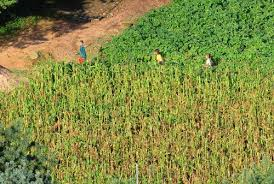
Yes. According to information received from
our sources on August 25, the evacuation drills, practiced after the
declaration of war caused a lot of grief to farmers in border areas like North and South Hwanghae Provinces. The drill participants would sneak into the farmers’ fields
at night and eat some of the crop. Farmers’ lives are regularly disrupted by
the frequent declarations of war and the accompanying drills, and now their
livelihoods have been harmed as well.
8. Even an ear of corn must be valuable to
the farmers, yet are there no compensation for those who’ve suffered loss due
to the drills?
Yes. For the residents to get governmental compensation
for their loss would be something out of a dream. Instead, those who voice
their displeasure against the fact that their crops were harmed in the course
of the drills are criticized by the Party officials. The officials say that a
matter of a few ears of corn is a trifle compared to the national crisis of a semi
state of war, and that the complainants are merely being stingy. In North Korea,
evacuation drills are an annual event in September, so that thieves will target
the homes that are left vacant during this time. The government doesn’t
compensate the losses of home valuables incurred during the drills. Hence, to suggest
to North Korea residents that the government compensate the loss of their crops is
laughable.
9. I’ve heard many refugees in South Korea say that
they reminiscence over the food that they ate in the North as they settle in the South. Does
corn from North Korea taste different from their counterparts in South Korea?
Yes, many refugees agree that the food at South Korean restaurants specializing in North Korean cuisine just doesn’t taste like it did at home.
I also was disappointed with North and South Hamheung-style noodles sold in South Korea. An older
woman also asked me the same question that you just asked. I couldn’t give her a
definite answer, but I told her that in North Korea, noodles were a delicacy and
therefore eaten occasionally. It must have tasted all the more better because
it was eaten so seldom. Most crops in North Korea are grown without any
fertilizer, giving them fresher, unaltered taste.
Moreover, seasoning is rarely used in North Korea, letting the clean, natural flavors of the produce stand on their own. I’ve heard that flavoring
is added even to corn in SK when being cooked. I think that the corn cooked in
North Korea was more delicious, even if it didn’t have any flavoring, for the same
reason. I wish that the North Korean residents who have been mobilized for farm work and
construction will stay safe and live to the hope that reunification will soon become
reality even if it seems like a dream in the midst of their difficult
lives.
*This segment reflects conditions for the
week of August 31-September 4.